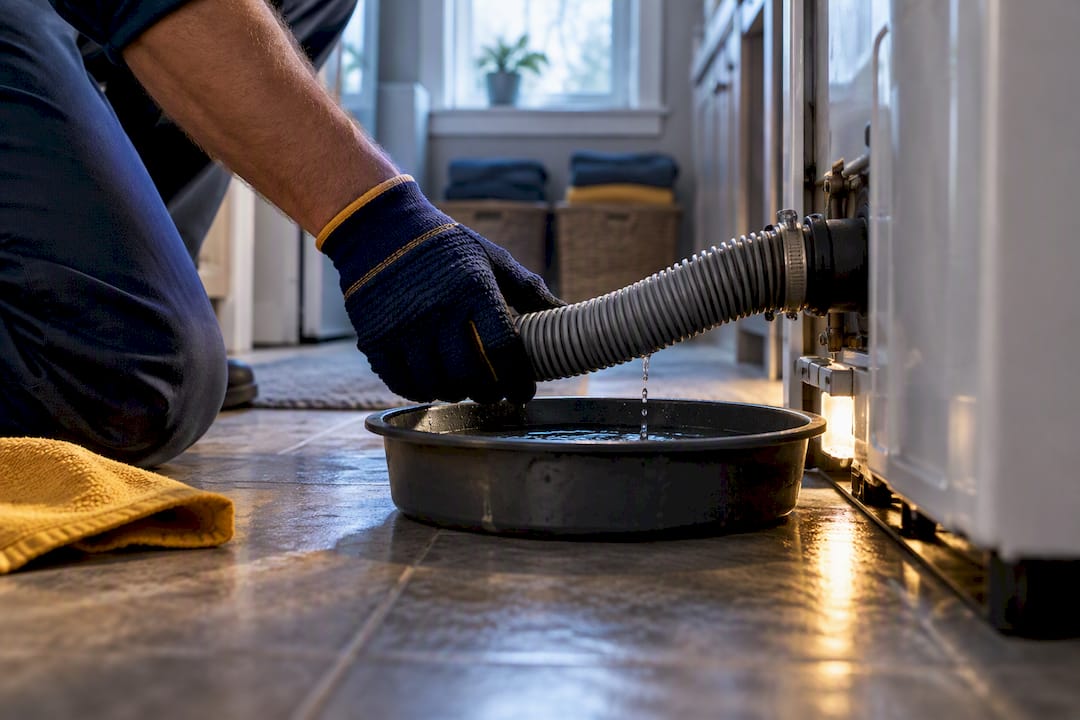
If your washer isn’t draining, unplug it, run a Drain & Spin cycle, and remove the standing water so you can look inside. In most cases the culprit is a clogged drain pump filter or a kinked, over-inserted drain hose, not a dead pump. Start there before you assume you need a repair.
TL;DR:
- Most washer drainage issues stem from clogged filters or kinked hoses, not a failed pump, making initial inspection simple and cost-effective.
- Properly removing standing water involves unplugging the machine, using the emergency drain hose or siphon, and staging buckets and towels to prevent messes.
- Clearing debris from the pump filter often resolves the no-drain problem in front-loaders within 10 to 20 minutes, while top-loaders may require technician help to access internal components.
- Faulty plumbing or incorrect hose installation can mimic pump failure, so testing the drain pipe and ensuring proper hose placement is essential before disassembling the machine.
- Pay attention to pump sounds during drainage: humming suggests impeller jams, strange noises indicate debris or worn bearings, and silence points to electrical or switch faults.
Table of Contents
- What to Check First When Your Washer Won’t Drain
- How Do You Safely Remove Standing Water From a Washer?
- How Do You Clean a Washer’s Drain Pump Filter?
- Could the Drain Hose or Plumbing Be the Real Problem?
- What Do the Sounds Your Pump Makes Actually Mean?
- When Is the Problem the Control Board, Not the Pump?
- What Does It Cost to Fix a Washer That Won’t Drain?
- Could a Worn Drive Belt Be Causing the Drain Problem?
- Is the Water Inlet Valve or Water Level Sensor to Blame?
- Does an Older Washing Machine Drain Worse Over Time?
- Technician Perspective: Why Most No-Drain Calls Are Fast Fixes
- Get Your Washer Fixed Right the First Time
- Where to Look Up Model-Specific Drain Codes
- Sources
- FAQ
What to Check First When Your Washer Won’t Drain
Before touching a single hose, rule out the cheap and obvious. Most no-drain calls turn out to be settings, suds, or a jammed filter, and you can test for all three in about five minutes.
- Run Drain & Spin. Most washers have this cycle built in, and it separates a simple software hiccup from a mechanical failure fast.
- Do a master reset. Unplug the machine for about 60 seconds, then plug it back in. This clears a lot of control-board confusion that mimics a real drain problem.
- Check your cycle and load. A single heavy item (one towel, one comforter) throws off the balance sensor and can stall the spin and drain step entirely.
- Write down any error code exactly as it appears. You’ll want this whether you fix it yourself or call someone.
- Listen to the pump. A humming sound with no water movement usually points to a jammed impeller or a dying motor, while total silence suggests the pump isn’t getting power at all, often a lid switch or door lock problem.
Too much detergent matters here too. Excess suds can extend an HE cycle by up to two hours as the washer repeatedly tries to clear foam instead of actually draining.
How Do You Safely Remove Standing Water From a Washer?
Unplug the washer before you do anything else. Then stage old towels, a shallow pan, and two buckets nearby. You’re about to get wet.
- Front-loaders: most models have an emergency drain hose tucked behind the small access panel near the bottom front, right next to the pump filter. Pull it loose, aim it into a shallow pan, and let gravity do the work before you crack open the filter cap itself.
- Top-loaders: scoop out what you can with a cup, then siphon the rest using a length of tubing, or disconnect the drain hose at the back and let it empty into a bucket on the floor.
- Never force a locked door or cut a rubber door seal to get at water faster. You’ll turn a $150 fix into a $400 one.
- Photograph any error codes and note what you tried. A technician can diagnose over the phone faster with this in hand.
Pro Tip: Keep a second bucket staged under the emergency drain hose before you open it. The first surge of water moves faster than people expect, and a dry floor saves you a mop-up on top of the repair.
How Do You Clean a Washer’s Drain Pump Filter?
Once the tub is empty, the filter (sometimes called the coin trap) is your next stop, and it’s the single most common fix for a washer that won’t drain.
- Find the small square access panel at the bottom front of the cabinet. Most front-loaders keep the filter behind it, right next to the emergency drain hose.
- Turn the cap slowly, counterclockwise, and let residual water drain into a shallow pan before you unscrew it the rest of the way. There’s almost always more water trapped behind that filter than you expect.
- Pull the filter fully out and check it for debris.
What you’ll usually find: coins, bobby pins, hair ties, a stray sock button, and a solid wad of lint. Clearing it typically resolves the drainage problem entirely, and the job itself takes about 10 to 20 minutes on most front-load machines.
Top-loaders are a different story. Most don’t have a user-accessible filter at all, which means a clog inside the pump housing usually requires opening the cabinet, a job better suited to a technician if you’re not comfortable with basic disassembly.
Could the Drain Hose or Plumbing Be the Real Problem?
Pull the washer away from the wall and look at the hose itself. A kink, a sharp bend behind the machine, or a section pinched under a cabinet foot can block water just as completely as a clogged pump.
- Check the hose end where it connects to the standpipe. It should sit a few inches inside the standpipe, but no deeper; manufacturer recommendations vary, so confirm the exact figure against your owner’s manual.
- Whirlpool’s own troubleshooting guidance flags incorrect hose installation and kinks as some of the most frequent causes of a no-drain complaint, right alongside a dirty filter.
- Test the standpipe directly. Disconnect the hose and pour a bucket of water straight down the pipe. If it backs up immediately, the problem is your home’s plumbing, not the washer.
- Standpipe height and hose insertion depth get misdiagnosed as pump failure more often than you’d think, especially in older homes with narrower standpipes than modern high-capacity washers expect.
If the backup test points to plumbing, call a plumber. Replacing a perfectly good pump won’t fix a clogged house drain.
What Do the Sounds Your Pump Makes Actually Mean?
The noise (or lack of it) coming from the pump during a drain attempt tells you almost everything you need to know before you pick up a tool.
- Humming with no water movement: the motor has power but the impeller is jammed, often by a small object that slipped past the filter, or the bearings are failing.
- Grinding or rattling: usually debris caught in the impeller housing, though it can also mean the bearings themselves are worn out.
- Total silence during the drain step: power isn’t reaching the pump at all. Check the lid switch or door lock interlock first, and check for a stored error code.
- Manual lid switch test: with the machine in drain mode, press the lid switch plunger by hand. If the pump kicks on, your switch or interlock assembly is the actual fault, not the pump.
- Multimeter check: test the lid switch for continuity, and check pump winding resistance against your model’s spec sheet. An open winding reads very differently from a jammed but functional motor, which is exactly the distinction you’re trying to make.
Pro Tip: If you’re not confident reading a multimeter, stop after the humming versus silence check. That alone tells a technician which two or three parts to bring on the first visit, and it saves you a return trip.
When Is the Problem the Control Board, Not the Pump?
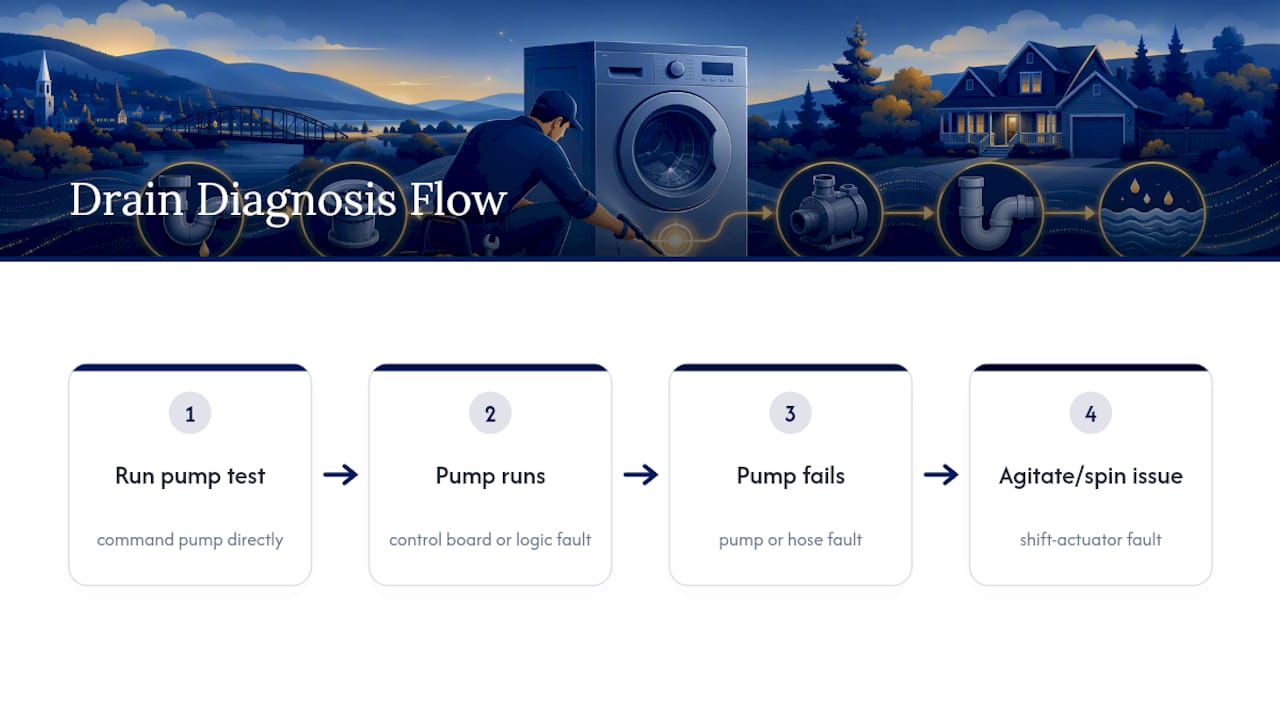
Most washers have a hidden diagnostic or test mode, usually triggered by a specific button sequence, that lets you command the drain pump directly without running a full cycle.
Here’s why that matters: if the pump runs fine in test mode but won’t fire during a normal cycle, the pump itself is probably not the problem. That points to a failed relay on the control board or a logic fault telling the pump when to run. Compare that to a shift-actuator fault on some top-loaders, which affects the switch between agitate and spin rather than draining directly, and produces a different symptom pattern (spins but won’t agitate, or vice versa).
Control-board diagnosis is where DIY troubleshooting should usually stop. Boards are expensive, the failure modes overlap with several other components, and a misdiagnosis means you’ve bought a part you didn’t need.
What Does It Cost to Fix a Washer That Won’t Drain?
Costs scale roughly with how deep into the machine the fix goes, and knowing that range helps you decide whether to keep troubleshooting or make a call.
- Clogged filter or hose: often free if you do it yourself, or a low-cost service call if you’d rather not.
- Pump replacement: a mid-range repair, parts plus labor, typically finished in one visit.
- Control board: the most expensive fix, both in parts and in diagnostic time, since boards can’t always be tested without specialized equipment.
Before you call anyone, gather your model and serial number, any error codes with photos, and a quick list of what you already tried. That alone can cut a first-visit diagnosis down to minutes instead of guesswork, and it means the technician can often bring the right part on the first trip instead of a second one.
Could a Worn Drive Belt Be Causing the Drain Problem?
On older top-loading washers, especially non-direct-drive models, a worn or slipping drive belt can look a lot like a drain failure even though the pump is fine. If the belt also drives the pump pulley (common on many older Whirlpool and Maytag top-loaders), a belt that’s cracked, glazed, or stretched loose won’t transfer enough force to spin the pump fast enough to clear the water.
Check it by unplugging the machine, removing the rear or bottom access panel, and looking at the belt directly. A healthy belt has a matte, slightly rubbery texture and sits snug around both pulleys. A bad one looks shiny and glazed on the contact surface, feels loose enough to slip a finger under with little resistance, or shows visible cracking along its length.
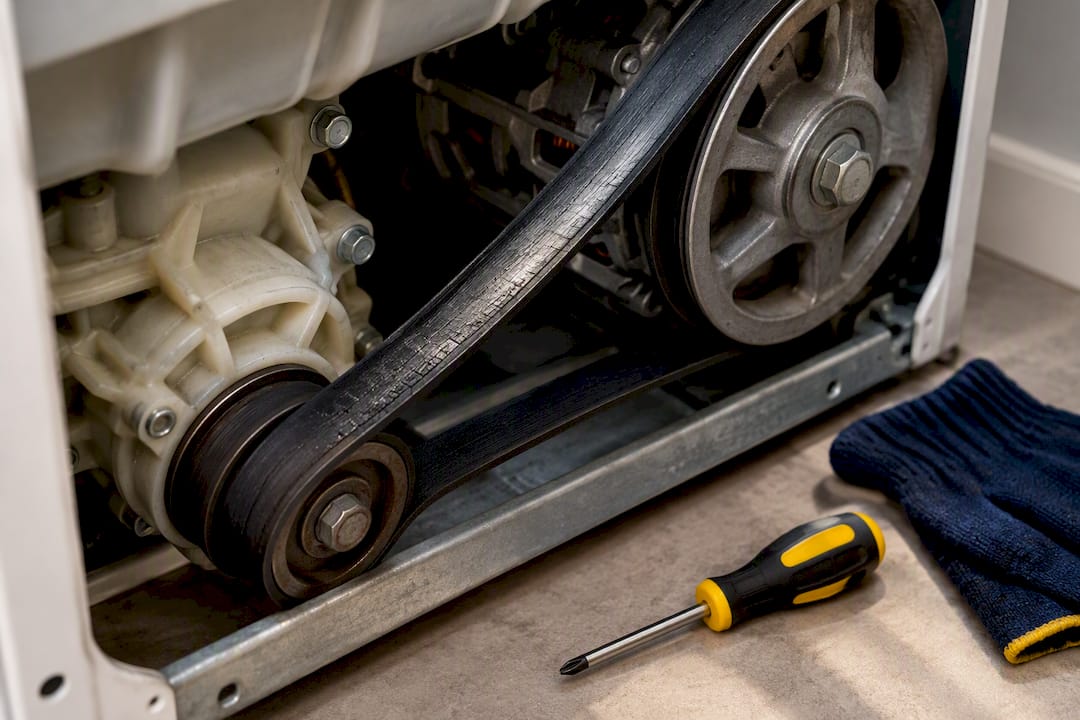
You can also spin the pump pulley by hand with the belt disconnected. If it spins freely and smoothly, the pump itself is likely fine and the belt is your problem. If it’s stiff, gritty, or won’t turn at all, you’re looking at a pump or bearing issue instead, and a new belt won’t fix it.
Most front-load washers and newer direct-drive top-loaders skip belts entirely, so this check applies mainly to older machines. Belts are inexpensive, usually under $20 in parts, but replacing one means working around the motor mount and tensioner, which is a reasonable weekend project if you’re comfortable with basic tools.
Is the Water Inlet Valve or Water Level Sensor to Blame?
A washer that won’t drain sometimes isn’t a drain problem at all. It’s a water problem disguised as one. If the machine keeps refilling during what should be a drain-and-spin step, or the water level never seems to match the load size, the inlet valve or the water level control could be misreading the situation and confusing the whole cycle.
The water inlet valve controls how much water enters the tub and when. A stuck-open valve keeps adding water even after the machine should have stopped, which can make it look like the washer never actually drained, when in reality it’s refilling faster than the pump can keep up. You can check this by running an empty cycle and watching whether water enters when it shouldn’t, particularly during a spin or drain step where no fill should occur.
The water level control, whether it’s a mechanical pressure switch or an electronic sensor reading an air column, tells the machine how full the tub is. On HE machines, this system can be fooled by excess suds pressing against the pressure sensor, which reads as “still full” and triggers repeated drain attempts or an extended cycle even when the tub is nearly empty. If you’ve been using more detergent than the HE line calls for, this is worth ruling out before you touch the pump.
Does an Older Washing Machine Drain Worse Over Time?
Age changes how a washer handles water in ways that aren’t always obvious. Rubber components, door seals, drain hose gaskets, and pump housing seats, all lose flexibility over the years, and stiff rubber creates small gaps where debris collects instead of flushing through.
Pump bearings wear down gradually rather than failing outright, so an older machine often shows early warning signs (a growing hum, a slight rattle, slower drain times) months before it stops draining completely. If your washer is eight to twelve years old and you’re noticing longer cycle times or more frequent filter clogs, that’s usually wear accumulating rather than a single new problem.
Mineral buildup from hard water compounds this over time too, gradually narrowing the passages inside the pump and drain hose. A five-year-old washer and a fifteen-year-old washer with the identical clog will often behave differently: the older machine’s pump has less reserve capacity left to push through partial blockages, so smaller clogs cause bigger symptoms. That’s part of why the same $10 filter cleaning fixes an older machine’s dramatic “full of water and won’t move” complaint just as often as it fixes a newer one’s minor slowdown.
Technician Perspective: Why Most No-Drain Calls Are Fast Fixes
After nearly 20 years of appliance calls across Southern New Hampshire, Another Cycle Appliance Repair has learned that most “my washer won’t drain” calls end the same way: a filter full of debris or a kinked hose, not a dead pump. Checking those two things first, before opening anything else, saves the homeowner money and saves the technician a wasted trip for a part they didn’t need. The instinct to assume the worst (a failed motor, a cracked pump housing) is understandable, but it’s usually wrong.
— Rich
Get Your Washer Fixed Right the First Time
If you’ve run through the filter check, the hose inspection, and the pump sounds test and you’re still standing over a tub of water, it’s time for a professional. This service is an alternative to guessing at parts online, providing in-person diagnosis, honest repair-or-replace advice before any work starts, and backing every job with a warranty on parts and labor.
A typical visit means a technician arrives, runs the same diagnostic order covered above but with the tools to test what you can’t, and hands you a written estimate before touching anything further. No surprise charges, no upsell on parts you don’t need. If you’d rather head off drain problems before they start, the Platinum Appliance Care plan covers preventive maintenance for $549 one time.
Ready to get it sorted? Book your washing machine repair online and get a real technician at your door, not a guess.
Where to Look Up Model-Specific Drain Codes
Every brand handles error codes and filter access a little differently, so it helps to have the manufacturer’s own instructions on hand once you know your model number.
- LG’s support library covers exact troubleshooting steps for drain and spin failures, including where to find the emergency drain hose on most front-load models.
- Whirlpool’s blog walks through the most common causes of drainage failure across its lineup, including hose installation mistakes.
- ServiceMag’s diagnostic guide breaks down pump sounds and testing procedures that apply across most brands, not just one manufacturer.
- Remove & Replace offers a practical walkthrough for emptying standing water safely before you inspect further.
Sources
- Washer Not Draining: Complete Diagnostic Guide for All Brands | ServiceMag
- Water still in washer? How to drain standing water fast | Remove & Replace
- LG Washer – Troubleshooting Washer Does Not Drain or Spin | LG USA Support
- Why is my washing machine not draining? | Whirlpool
FAQ
Why Is My Washer Stuck Full of Water?
Standing water almost always means the drain pump isn’t moving water out of the tub, either because the filter or hose is clogged, the pump itself has failed, or the machine isn’t sensing that it should drain. Unplug the machine, remove the water using the emergency drain hose or a siphon, then check the filter before assuming the pump is broken.
How Do I Know If It’s the Pump or Just a Clog?
Listen during the drain attempt. A humming sound with no water movement suggests a jammed or failing pump, while clearing a clogged filter resolves most no-drain cases without needing a new pump at all. If you hear nothing, check the lid switch or door lock first.
Can Too Much Detergent Really Stop a Washer From Draining?
Yes. Excess suds on HE machines can extend a cycle by up to two hours as the machine repeatedly tries to clear foam, which looks identical to a drain failure from the outside. Switching to the correct HE detergent amount usually solves it.
How Much Does Anothercycleappliance Charge to Fix a Washer That Won’t Drain?
Pricing depends on what’s actually wrong, since a filter cleaning and a pump replacement are very different jobs. Current pricing is available when you book a washing machine repair online, and every visit includes a written estimate before any repair work begins.
Should I Call a Plumber or an Appliance Technician?
If pouring water directly down the standpipe causes an immediate backup, that’s a plumbing problem and calls for a plumber. If the standpipe drains clean but the washer still won’t clear water, the issue is inside the machine, and that’s an appliance technician’s job.