Most ice maker repairs run between $75 and $660 total, with the average homeowner paying somewhere around $200 to $300 once the diagnostic fee, labor, and parts are added up. A simple fix like a clogged line lands at the low end; a control board or motor replacement pushes toward the high end. If your quote comes in near half of what a new unit would cost installed, replacement usually makes more financial sense than another repair.
TL;DR:
- Repair costs typically range from $75 to $660, with most homeowners paying around $200 to $300 for parts, labor, and diagnostics.
- The diagnostic fee is usually $50 to $150, often credited toward the repair if authorized immediately; skipping repairs still incurs this cost.
- Repairs on built-in or undercounter ice makers are more expensive, often exceeding $300, compared to simpler portable or refrigerator-integrated units.
- Common issues like water line clogs or faulty inlet valves usually cost $70 to $200 to fix, while control board or motor replacements can hit $300 or more.
- If repair costs approach or exceed 50% of the price of a new unit, especially for older models, replacement is usually the more economical choice.
Table of Contents
- Breaking Down Ice Maker Repair Cost: Diagnostic, Labor, and Parts
- What Each Repair Type Actually Costs
- Does Your Ice Maker Type Change the Price?
- Hidden Factors That Push Your Bill Higher or Lower
- What You Can DIY and When to Call a Professional
- Repair or Replace: When the Math Stops Making Sense
- How to Get an Estimate You Can Actually Trust
- A Note on Fair Pricing
- Get Your Ice Maker Fixed Right the First Time
- Sources
- FAQ
Breaking Down Ice Maker Repair Cost: Diagnostic, Labor, and Parts
A repair bill isn’t one number. It’s three separate charges stacked on top of each other, and understanding each piece is what lets you sanity check a quote instead of just trusting it.
The diagnostic or service call fee is what a technician charges to show up and figure out what’s wrong. That typically runs $50 to $150, though some local shops price it closer to $60 to $100. Here’s the part most homeowners don’t realize until they ask: many companies credit that fee toward the repair if you approve the work on the spot. Skip the repair, and you often still owe the diagnostic charge for the visit.
Labor is billed hourly, and rates commonly fall between $70 and $125 per hour. Simple jobs like swapping a water filter or clearing a jam take 30 minutes to an hour. A motor or control board swap can take one to four hours depending on how easy the unit is to access and whether the part is on the truck or needs ordering.
Parts vary the most. A basic component might cost $20; a full control board assembly can run $350 or more, especially with an OEM (original equipment manufacturer) part instead of an aftermarket substitute. OEM parts typically cost more upfront but fit better and carry manufacturer backing, which matters if your appliance is still under warranty.
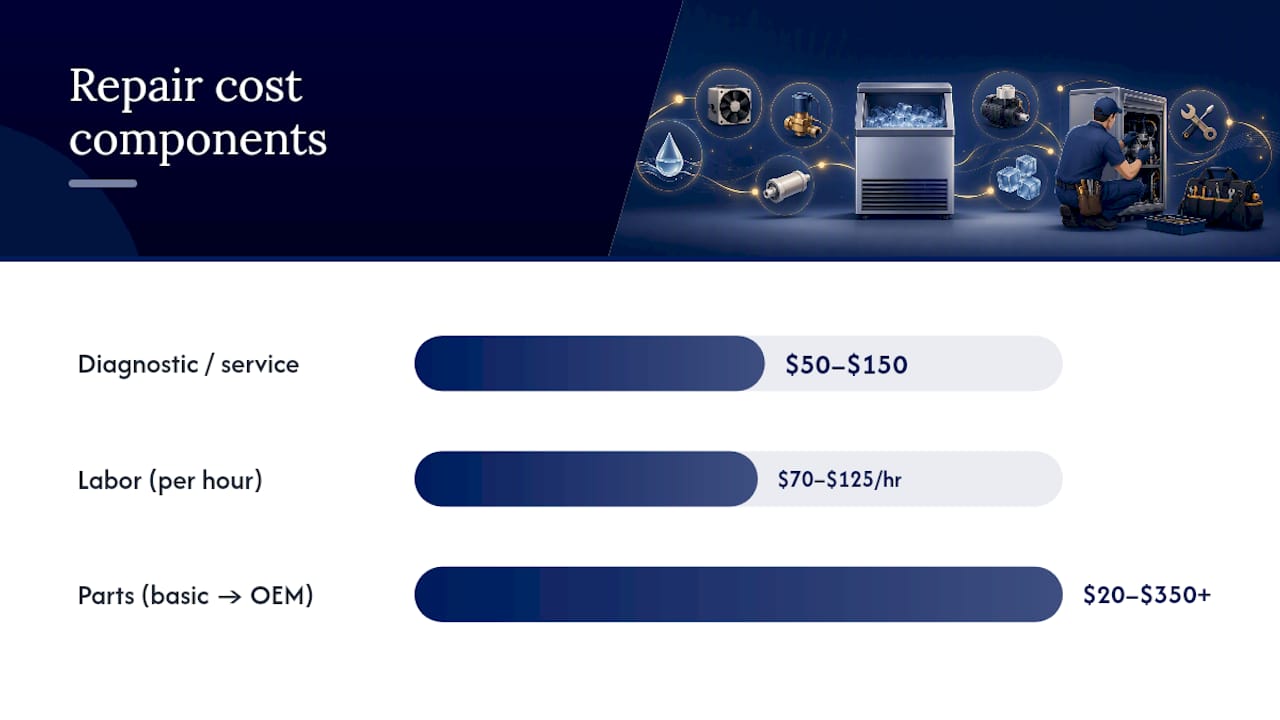
Here’s how those three pieces combine in practice:
A few things that swing these numbers in either direction:
- Older units sometimes need discontinued parts, which cost more and take longer to source.
- Built-in and undercounter models often add labor time just for access.
- Multiple failed components in one visit (a common outcome when a unit has been ignored for months) stack labor and parts costs quickly.
What Each Repair Type Actually Costs
Your symptoms point pretty directly to the part that’s failing, and each part has its own price range. Knowing which one you’re dealing with saves you from guessing blind on the phone with a technician.
- No water filling the tray: Usually a faulty water inlet valve, running $90 to $225 parts and labor combined.
- Ice maker not cycling or producing anything: Often points to the control board, one of the pricier fixes at $150 to $300.
- Ice won’t harden or forms slush: Typically a thermostat or temperature sensor issue, generally a lower-cost repair in the $80 to $180 range.
- Grinding noise or ice maker stuck mid-cycle: Points to the motor or gear assembly, which runs $120 to $400 depending on the model.
- Slow ice production or dripping: Frequently a clogged or frozen water line, one of the cheaper fixes at $70 to $200.
Quick reference: Fixr places the national average ice maker repair at around $200, with most jobs landing between $150 and $250. Anything above that typically involves a control board or motor.
Water line clogs, worn inlet valves, and cracked ice molds are the repairs technicians see most often, and they’re also the ones that cause the least damage if you catch them early. Left alone, a stuck valve or a slow leak can eventually strain the refrigerator’s cooling system and turn a $150 fix into a much bigger one.
Does Your Ice Maker Type Change the Price?
Not all ice makers cost the same to fix, and the type of unit you own is often a bigger factor than the actual part that failed.
Built-in and undercounter ice machines sit at the top of the cost range. They’re plumbed into water and drain lines, often built into cabinetry, and sometimes involve a sealed refrigeration system, all of which add labor time and complexity. Repairs on these units commonly run higher than refrigerator-integrated or portable models.
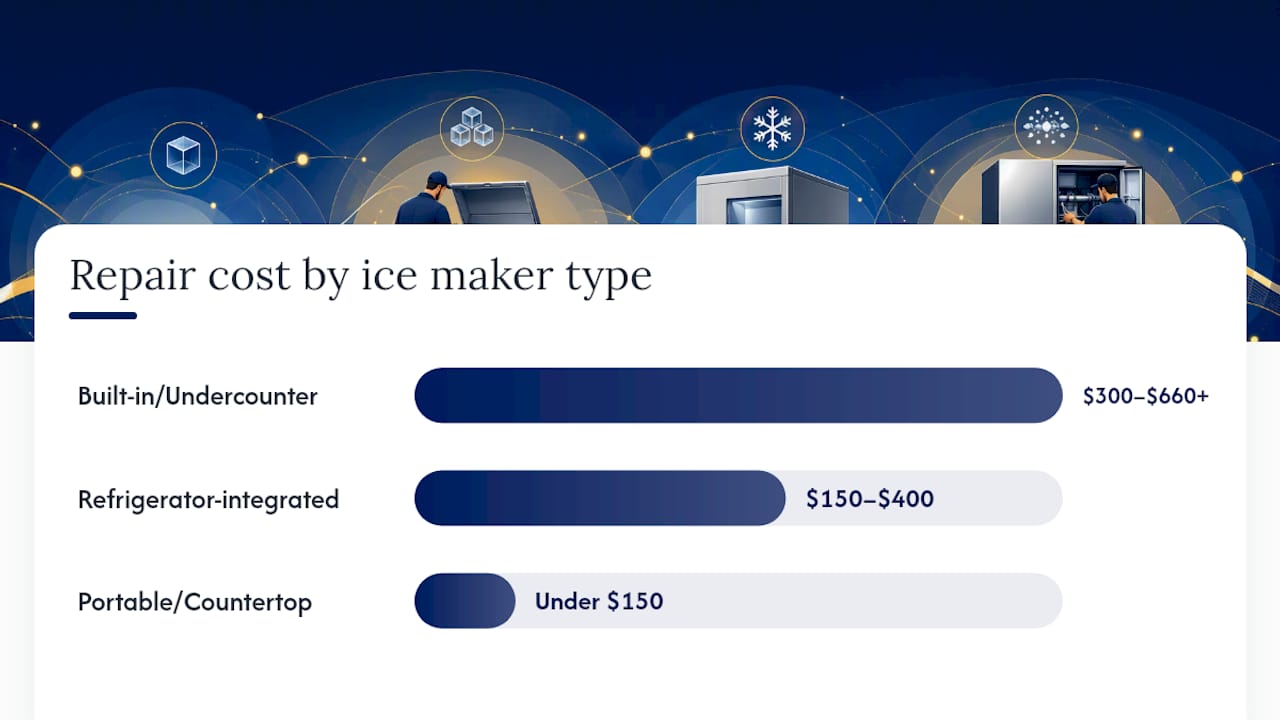
Refrigerator-integrated ice makers, the kind built into your fridge’s freezer compartment, fall in the middle. Parts are usually easier to source since they’re common across many refrigerator brands, but access sometimes means partially disassembling the freezer.
Portable and countertop ice makers are the cheapest to service, and often the cheapest to simply replace outright. Given their low retail price, many technicians will tell you upfront that replacement beats repair once you’re past a $60 to $80 part.
- Built-in/undercounter: highest cost, often $300 to $660+ for major repairs.
- Refrigerator-integrated: moderate cost, typically $150 to $400.
- Portable/countertop: lowest cost, usually under $150, and frequently not worth repairing at all.
Hidden Factors That Push Your Bill Higher or Lower
Two homeowners with the identical broken part can get very different quotes, and it usually comes down to a handful of variables that rarely show up until you ask.
OEM versus aftermarket parts is the biggest lever. OEM parts cost more but match your appliance’s specs exactly and typically preserve manufacturer warranty coverage. Aftermarket parts save money upfront but can void warranty protection on newer units.
Emergency or after-hours service adds a surcharge, commonly 20% to 50% on top of standard labor rates. If your ice maker dies on a Friday night and you need same-day service, expect to pay for that convenience.
Warranty status changes everything. If your appliance is still under a manufacturer’s warranty, parts (and sometimes labor) may be covered outright. Once that expires, a separate service provider warranty on parts and labor becomes your only protection against a repeat failure.
Unit age and repair history matter too. A machine that’s already had one component fail is statistically more likely to need another repair soon, since related parts endure the same wear.
- Ask whether the quote uses OEM or aftermarket parts before agreeing.
- Confirm any after-hours or emergency fee before scheduling.
- Ask what warranty (manufacturer or service provider) applies to the repair.
Pro Tip: Ask your technician for the part number before they order anything. That single question lets you confirm whether it’s an OEM or aftermarket component, and whether a cheaper equivalent exists, before you’re locked into the price.
What You Can DIY and When to Call a Professional
Some ice maker problems are genuinely simple enough to handle yourself. Others carry real risk to your safety, your warranty, or your wallet if you get them wrong.
Homeowner-friendly fixes include swapping a water filter (usually $20 to $60 for the part), clearing a visible ice jam, and power-cycling the unit by unplugging it for a few minutes. These cost little more than the part itself and carry no real risk.
Anything involving wiring, the motor, the control board, or a sealed refrigeration system is a different story. Electrical components can shock you if handled wrong, refrigerant lines require licensing to service legally, and opening up a sealed system yourself almost always voids whatever warranty remains on the appliance. Persistent leaks also deserve a professional look, since water intrusion near electrical components is a fire and shock hazard, not just a nuisance.
- DIY-safe: filter changes, clearing visible jams, basic resets.
- Call a pro: electrical faults, motor or control board failures, sealed-system issues, recurring leaks.
Pro Tip: If a repair involves removing a panel to reach wiring, that’s your line in the sand. Past that point, a licensed technician protects both your safety and your warranty.
Anothercycleappliance has spent nearly 20 years doing in-home repairs across Southern New Hampshire, and every job carries a one-year warranty on parts and labor, which is the kind of guarantee a DIY fix simply can’t offer.
Repair or Replace: When the Math Stops Making Sense
Professionals commonly lean on a simple benchmark: if the repair quote runs close to half the price of a comparable new unit installed, replacement is usually the smarter long-term move. This is sometimes called the 50% rule, and it works because a big repair bill on an aging machine rarely buys you many more years of reliable service.
Age is your tiebreaker. A five-year-old refrigerator-integrated ice maker with a $250 quote is probably worth fixing. A twelve-year-old unit with the same quote, especially if it’s had a prior repair, is a better candidate for replacement.
Built-in units are the exception worth flagging. Because replacement costs for these can run high once you factor in cabinetry and plumbing work, even a repair that approaches the 50% mark can still be the more practical choice.
- Compare your quoted repair cost to the installed price of a new equivalent unit.
- Weigh the unit’s age and any prior repairs as a tiebreaker.
- Treat built-in units as a partial exception, since replacement labor runs higher.
How to Get an Estimate You Can Actually Trust
A reliable quote depends on giving the technician enough information upfront, and asking the right questions before you agree to anything.
- Gather your model and serial number before you call. It’s usually on a sticker inside the freezer or on the appliance frame.
- Describe the exact symptom (no water, no ice, grinding noise, slow production) and take a photo or short video if the issue is visible or intermittent.
- Ask about the diagnostic fee and whether it applies toward the repair cost if you move forward.
- Ask for a labor hour estimate and confirm OEM part availability before work begins.
- Confirm the warranty on both parts and labor before you sign off.
Watch for red flags: a technician who won’t break down parts versus labor, one who pushes full assembly replacement before even diagnosing the problem, or a quote so vague it can’t be compared to anything else you’ve received.
Pro Tip: Get two quotes only if the first one feels rushed or vague. A technician confident in their pricing will happily walk you through the breakdown line by line.
A Note on Fair Pricing
Rich here. After nearly two decades repairing appliances across Southern New Hampshire, the complaint I hear most isn’t about repair costs. It’s about not knowing what you’re paying for. We quote diagnostic fees upfront, explain every line item, and back every job with a one-year warranty on parts and labor. If your ice maker’s acting up, schedule a diagnostic and get a straight answer.
— Rich
Get Your Ice Maker Fixed Right the First Time
Anothercycleappliance is the alternative to guessing your way through a repair or gambling on a stranger’s quote in Southern New Hampshire. We charge a clear diagnostic fee, explain parts and labor before any work starts, and back every completed repair with a one-year warranty on parts and labor, so you’re not paying twice for the same problem. Whether it’s a jammed water valve or a full refrigerator ice maker replacement, our technicians handle it in your home, on your schedule. Check our service area and browse our repair services to see what’s covered, then book a diagnostic visit when you’re ready for a straight answer instead of a guess.
Sources
- How Much Does Ice Maker Repair Cost? 2026 Data
- How Much Does It Cost to Repair an Ice Maker? 2025 Data
- Fixr
- Ice Maker Repair Cost and Price Guide – Current Cost
FAQ
Is It Worth Fixing an Ice Maker?
Usually, yes, if the repair costs less than half the price of a new comparable unit installed. Most repairs fall in the $150 to $300 range, which is typically far cheaper than replacing a built-in or undercounter unit.
What Is the Life Expectancy of an Ice Maker?
Most refrigerator-integrated ice makers last as long as the refrigerator itself, though components like water valves and motors can fail sooner. Standalone and portable units tend to have shorter lifespans due to lighter-duty parts.
What Is the Most Common Reason an Ice Maker Stops Working?
A faulty water inlet valve is one of the most frequent culprits, often showing up as no water filling the tray. Clogged or frozen water lines and worn ice molds are close behind on the list of routine failures.
Can an Ice Maker Be Repaired?
Most ice maker problems, including valve failures, motor issues, and control board faults, are repairable rather than requiring full replacement. Total repair costs typically range from $75 to $660 depending on what failed, and some companies offer in-home repairs with warranties on their work.