A complete oven repair, including the service call, diagnostic work, parts, and labor, typically lands between $125 and $350, according to Yelp’s cost data. Another Cycle Appliance Repair sees this pattern hold across most jobs: when the quote stays well under half the cost of a new installed oven and the unit is under 10 years old, repair almost always makes more financial sense than replacement.
TL;DR:
- Most oven repairs range from $125 to $350, with common issues like igniters and heating elements costing $100 to $300 to fix.
- Diagnostic or service call fees generally add $50 to $150 upfront, which may be credited towards the repair if authorized.
- Repair costs are more justified on ovens under 10 years old when the bill is less than half of installing a new unit; beyond that age, replacement may be wiser.
- Replacement parts like control boards can cost $200 to $500, with complex or rare models increasing total expenses due to special parts or labor.
- Accurate quotes should be itemized, obtained in writing, and consider full replacement costs to determine if repair remains a financially sound choice.
Table of Contents
- What a typical oven repair invoice looks like
- Common failures and what each one actually costs
- What actually moves your final price up or down
- Deciding whether to repair or replace your oven
- Getting an accurate quote before the technician arrives
- Why homeowners trust these numbers
- The number homeowners should actually focus on
- Getting your oven fixed without the guesswork
- Sources
- FAQ
What a typical oven repair invoice looks like
Most homeowners land in one of three cost tiers depending on what broke and how much labor it takes to fix.
- Low end, around $100 to $125: minor fixes like a thermal fuse swap or a simple door gasket replacement, according to Yelp.
- Typical range, $200 to $400: the most common repairs, including igniters, heating elements, and thermostats, based on median figures from a Consumer Reports ranges survey.
- High end, $400 and up: control board replacements or jobs requiring hard-to-source parts on older or premium models.
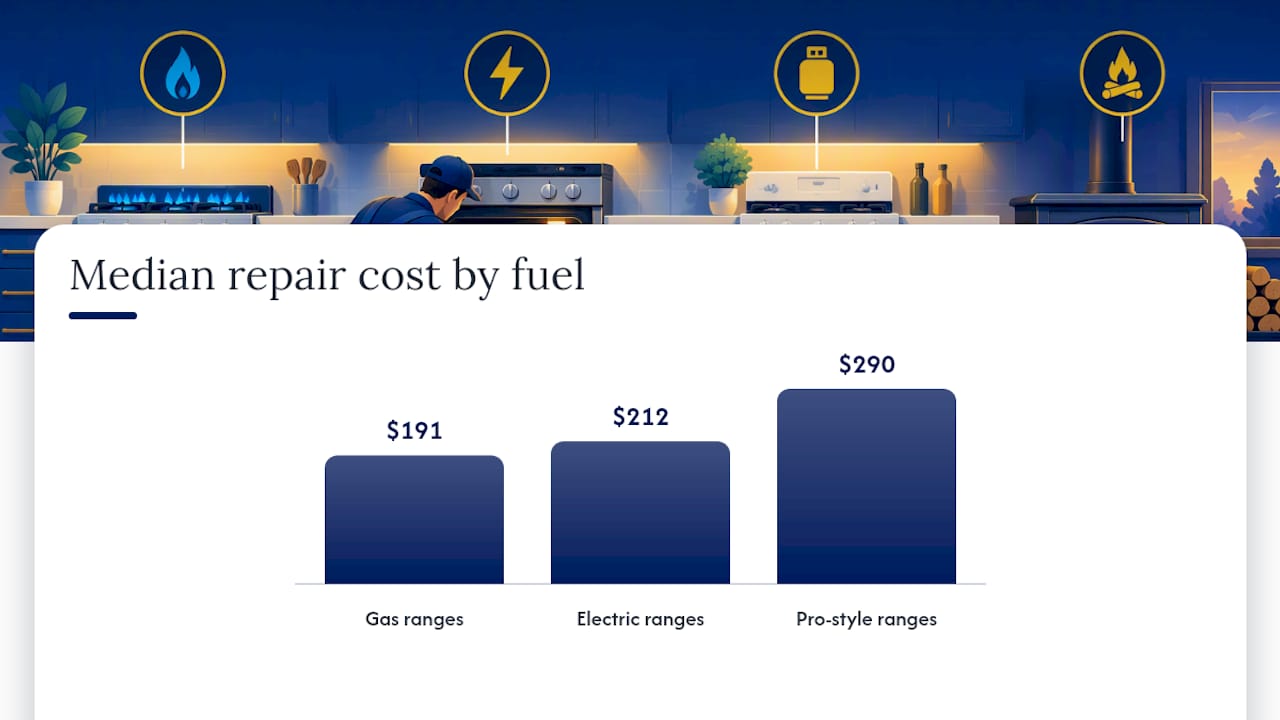
The Consumer Reports survey breaks median repair costs down by fuel type: gas ranges came in at $191 and electric ranges at $212, with pro-style ranges averaging $290. Those numbers reflect completed repairs only, a point worth keeping in mind before you compare your own quote to a published average.
Nearly every technician charges a diagnostic or service call fee upfront, generally $50 to $150 nationally, according to Yelp’s data. Many companies apply that fee toward the final repair cost if you move forward with the work, but not all do, so ask before the technician steps out of the truck. If you decline the repair after diagnosis, expect to pay the service fee alone.
Gas ovens and electric ovens land in similar overall price territory, but the specific parts that fail, and their labor requirements, differ enough to shift where in the range your bill falls. A gas igniter job tends to run cheaper in parts but can take longer to access safely. Electric heating elements are often simpler to swap but the part itself can cost more on certain brands.
Common failures and what each one actually costs
Knowing what a specific repair should cost helps you spot a fair quote from an inflated one. Prices below reflect combined parts and labor unless noted.
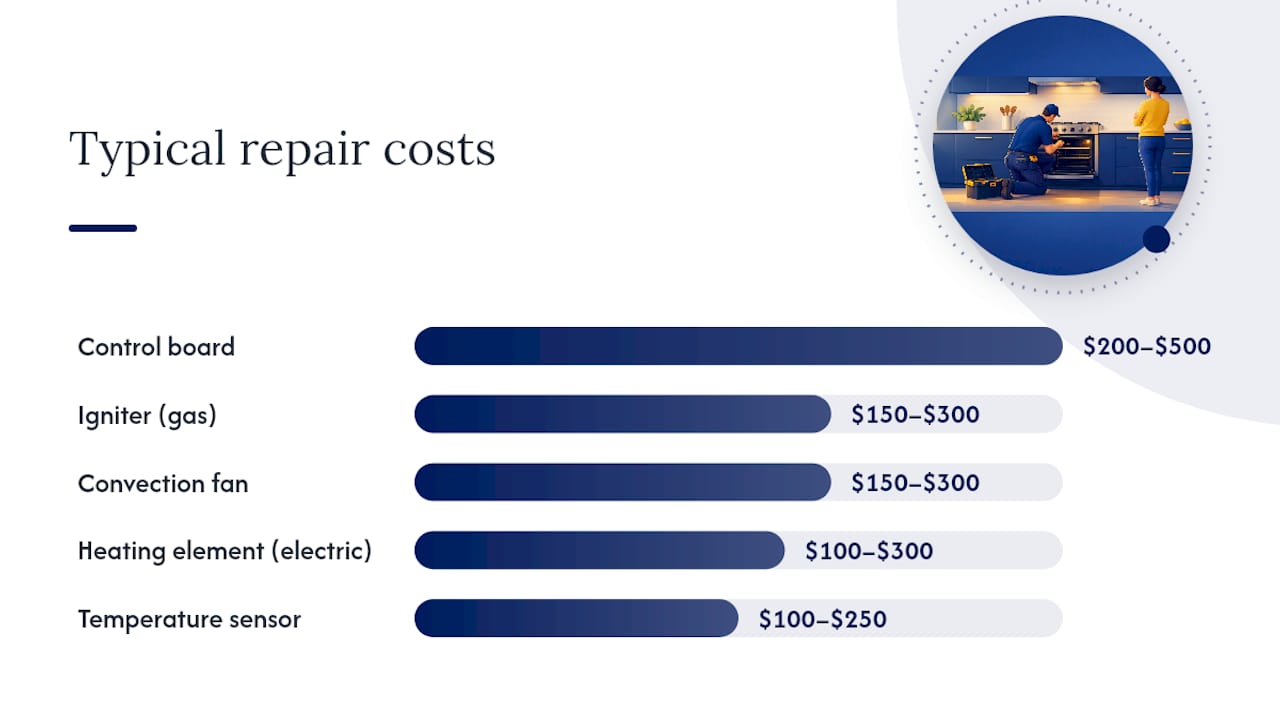
- Igniter (gas ovens): often $150 to $300 installed. The part itself is inexpensive, but labor to access and replace it safely raises the total.
- Heating element (electric ovens): typically $100 to $300 installed, cheaper if you’re comfortable with a DIY swap but most homeowners hire it out for safety and warranty reasons.
- Control board or control panel: frequently $200 to $500 or more, making it one of the priciest single repairs on any oven.
- Temperature sensor or thermostat: usually $100 to $250, a relatively quick fix in most models.
- Door gasket or latch: generally $75 to $200 depending on whether the door mechanism needs disassembly.
- Convection fan: typically $150 to $300, higher if the motor itself needs replacing rather than just the blade.
- Thermal fuse: among the cheapest common repairs, often under $150 total.
A published dataset of completed repair invoices from independent repair businesses shows a median oven and range repair cost near $350, with igniters, heating elements, and control boards ranking as the most frequent failures. That figure tracks closely with the aggregate ranges reported by both Yelp and Consumer Reports, which is a useful sanity check when a quote seems unusually high.
Two variables push individual repairs above these bands. First, part-only versus part-plus-labor: a control board might cost $150 as a part but $450 once you add the labor to remove panels, test wiring, and reprogram settings. Second, brand and model scarcity: premium or discontinued models often require special-order parts, which adds both cost and wait time.
What actually moves your final price up or down
Two technicians can quote wildly different totals for the same symptom, and the gap almost always traces back to a handful of variables.
- Labor structure: some companies charge hourly, others use flat-rate pricing per job type, which tends to be more predictable for the homeowner.
- Travel and service fees: rural or off-hours calls often carry a premium on top of the base diagnostic fee.
- OEM versus aftermarket parts: original manufacturer parts cost more but generally fit better and carry stronger warranties than generic substitutes.
- Gas line complexity: any repair that involves disconnecting or modifying a gas line may require a licensed gas technician rather than a general appliance repair person, which adds cost but is a safety necessity, not an upsell.
- Warranty coverage: if your oven is still under manufacturer warranty or you’re enrolled in a home service plan, your out-of-pocket cost could drop to near zero.
- Timing: same-day or after-hours service typically carries a premium over a scheduled weekday appointment.
Pro Tip: Ask upfront whether the quote is flat-rate or hourly. Flat-rate pricing protects you if the job takes longer than expected.
Deciding whether to repair or replace your oven
Consumer Reports frames the repair-or-replace decision around three variables: the appliance’s age, the repair cost, and what you originally paid for it, and recommends weighing the quoted repair against the full installed cost of a new oven, not just the sticker price of a replacement unit.
A simple three-step process works for most homeowners:
- Get the repair quote in writing, including parts, labor, and any service fee.
- Compare that number to the installed cost of a new oven, meaning the unit price plus delivery, installation, and disposal of the old one, not just what you’d pay at checkout.
- Factor in age. If the oven is under 8 years old and the repair costs less than half the installed replacement price, repair is usually the better financial move. Past 12 to 15 years, even a moderate repair bill starts to look less appealing since another failure may follow soon.
Say a homeowner gets a $320 quote to replace a control board on a 6-year-old oven that would cost $1,400 installed to replace.
The Department of Energy finalized new efficiency standards for residential cooking products in January 2024, projected to save households roughly $1.6 billion in utility costs over 30 years. That’s meaningful context for long-term operating costs, but it’s a multi-decade horizon, not a reason to replace a working oven over a single repair bill.
One more caution: published median repair costs, including the ones in this guide, generally reflect only completed repairs. Homeowners who got a quote and chose replacement instead aren’t counted, which can make repair look cheaper on paper than the full range of real-world outcomes.
Getting an accurate quote before the technician arrives
A little preparation before your appointment leads to tighter, more comparable estimates.
- Have your model and serial number ready, along with any error codes displayed on the oven’s panel.
- Describe the exact symptom, such as “won’t heat past 300 degrees” rather than “oven’s broken.”
- Take a photo or short video of the issue if it’s intermittent or hard to describe.
- Ask whether the diagnostic fee applies to the repair cost if you move forward with the work.
- Ask about parts source and warranty, specifically whether the technician uses OEM or aftermarket parts and how long the parts and labor are covered.
- Get the estimate in writing before work begins, and treat a verbal-only quote with caution.
If the issue involves gas line work or complex electrical wiring beyond the oven’s internal components, confirm the technician is licensed for that specific work or ask them to bring in a specialist. Most appliance repair companies can handle oven repairs directly, but gas connections sometimes require a separate credential depending on local code.
Why homeowners trust these numbers
Another Cycle Appliance Repair has spent nearly 20 years repairing appliances in homes across Southern New Hampshire, and that hands-on experience shapes the price bands and decision framework in this guide. The company backs every repair with a one-year warranty on parts and labor, and its pricing approach centers on transparency: homeowners get honest repair-or-replace advice rather than a push toward the more expensive option. That combination, straightforward pricing plus a warranty that protects the work after the technician leaves, is the standard this guide measures every cost estimate against.
The number homeowners should actually focus on
Most oven repair advice fixates on the wrong number: the total dollar figure. What actually matters is the ratio between that figure and the installed cost of a new oven, plus how many good years the appliance has left. A $400 repair on a 3-year-old oven and a $400 repair on a 14-year-old oven are not the same decision, even though the invoice looks identical.
The conventional wisdom to “always get three quotes” is fine advice but incomplete. It’s more useful to get one detailed, written quote and ask the technician directly why the price lands where it does. A vague number tells you nothing. A number broken into parts, labor, and service fee tells you whether you’re paying for a control board or paying for someone’s guesswork.
If you take one thing from this guide, let it be this: don’t decide based on the repair cost alone. Decide based on the repair cost as a fraction of what replacement would actually cost you, installed and disposed of, not just the price tag on the showroom floor.
— Rich
Getting your oven fixed without the guesswork
Once you know your oven’s problem falls into a normal repair band rather than replacement territory, the next step is getting an honest, accurate quote instead of a stab in the dark. Another Cycle Appliance Repair provides in-home oven repair across Southern New Hampshire with transparent pricing and a one-year warranty on parts and labor, so you’re not left guessing what happens if the same issue comes back a few months later.
If your oven is getting older and you’d rather catch small problems before they become expensive ones, the Platinum Appliance Care plan, priced at $549 one-off, covers routine maintenance across your household appliances rather than waiting for a breakdown to call. For a same-week fix, you can schedule service online and get a technician looking at your oven with your model number and symptoms already on file.
Sources
- DOE: DOE finalizes cost-saving efficiency standards for new cooking products
- Should You Repair or Replace Your Broken Range? – Consumer Reports
- How much does Oven repair cost? – Yelp
FAQ
Is it worth it to repair an oven?
Repair is usually worth it when the quoted cost is well under the installed price of a new oven and the unit is under about 8 to 10 years old. Consumer Reports recommends weighing age, repair cost, and original purchase price together rather than looking at the repair bill in isolation.
What’s the average lifespan of an oven?
Most ovens last well into their second decade with normal use and occasional repairs, though exact lifespan varies by brand, usage, and maintenance habits. Once an oven passes the 12 to 15 year mark, each new repair carries higher odds that another failure will follow soon after.
Can an electrician fix an oven?
A licensed electrician can handle electrical faults like wiring issues, but most oven repairs, including igniters, heating elements, and control boards, are better handled by an appliance repair technician trained on that specific system. Gas oven work may require a technician or specialist licensed for gas line connections depending on local code.
How much does it cost to replace an oven control board?
Control board replacement typically runs $200 to $500 or more once parts and labor are combined, making it one of the priciest single-component oven repairs. The exact price depends on whether the board is a common part in stock or a special-order item for an older or premium model.