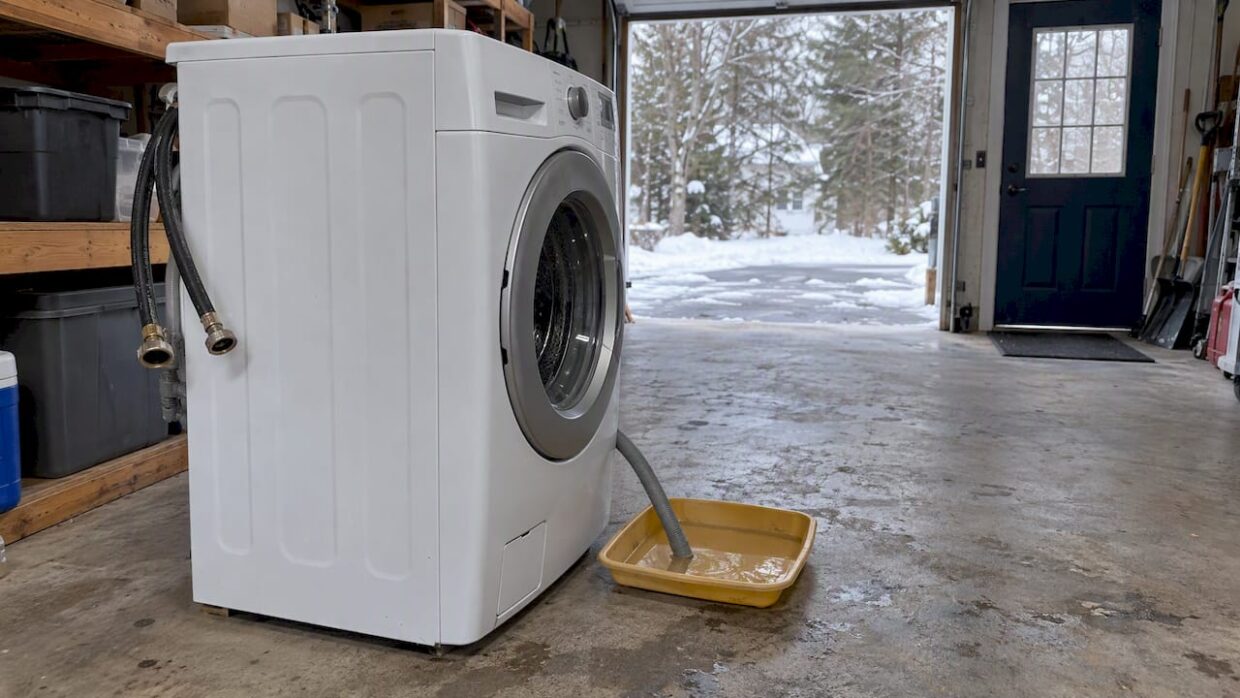
To winterize a washer in an unheated New Hampshire garage, shut off the water, unplug the machine, disconnect and drain the hoses, tilt the washer to empty the pump, then add non-toxic RV antifreeze to the drum and run a short spin. Do that before the first hard freeze and the water that stays trapped inside can’t crack anything. Below are the full steps, what can go wrong, and how to bring the machine back in spring.
TL;DR
- Water left in the inlet hoses, pump and drain line is what freezes and damages a washer. Getting it out is the whole job.
- The core steps: water off, power off, hoses disconnected and drained, machine tilted 4 to 6 inches, then 1 gallon of non-toxic RV antifreeze and a 1-minute spin-only cycle (per LG).
- Manufacturers can void the warranty if a washer sits in freezing temperatures unprotected, so read your manual before you start.
- In spring, let the machine warm up for 24 hours, reconnect the hoses and run an empty cleaning cycle to flush out the antifreeze.
- If the machine froze before you got to it, don’t run it. Wait for it to thaw, then have a technician check it.
Table of Contents
- Why an unheated garage is hard on a washer
- Decide first: use it, move it or winterize it
- What you need
- How to winterize a washing machine, step by step
- Protecting the pipes behind the machine
- What if the washer already froze?
- Bringing the washer back in spring
- Our perspective on garage washers
- When to call a technician
- Need help with a garage washer?
- FAQ
- Sources
Why an unheated garage is hard on a washer
A washing machine is full of small pockets where water hides: the inlet valves, the supply hoses, the pump housing and the drain hose. Even after a normal cycle ends, moisture stays in those parts. One storage-industry source points out that supply hoses and pump housings hold trapped water that needs to be drained by hand. When that water freezes it expands, and plastic fittings, valves and pump parts are the first things to give.
New Hampshire garages without heat regularly drop well below freezing from December through February, and cold snaps can arrive earlier or linger into spring. A washer that ran fine in October can be a problem by January.
Manufacturers are fairly clear about this. Danby states that its washers are not designed for locations without temperature control and that unsuitable placement voids the warranty. LG says that exposing a washer to below-freezing temperatures without protection will invalidate the warranty. GE takes a more practical view: storing a washer in an unheated space like a garage is acceptable if the machine is properly winterized.
The takeaway: a washer can spend the winter in a cold garage, but only empty of water and prepared on purpose. If you use the machine weekly all winter, the better answer is a heated space. If you are storing it or the garage is only a seasonal laundry spot, winterizing is the way to go.

Decide first: use it, move it or winterize it
Before you pick up a wrench, be honest about how you use the machine.
| Situation | Best approach |
|---|---|
| Washer is your daily laundry machine in the garage | Move it to a heated space if you can. Winterizing means no laundry until spring. |
| Washer is a spare or seasonal machine | Winterize it now, before the first hard freeze. |
| Garage is attached and sometimes warm from the house | Still winterize if temperatures there can fall below freezing. A warm afternoon does not protect a cold night. |
| Water already froze in the machine | Do not run it. See the section on frozen machines below. |
If you keep a refrigerator in the same garage, it has its own cold-weather problems. Our guide on winter fixes for garage refrigerators covers those.
What you need
You don’t need special tools. Gather these before you start:
- Towels and a shallow pan or baking tray to catch water
- Pliers (for hose connections that are tight)
- Non-toxic RV antifreeze, 1 gallon (the type LG specifies for its washers)
- Your owner’s manual, or the model number so you can look it up
- A helper if the washer is heavy, since you will be tilting it
Check the manual first. Manufacturers differ on details, and the manual tells you where the drain hose and pump filter sit on your model. One appliance repair expert quoted in a home publication advises checking the user manual to find the drain hose if you are unsure before disconnecting anything.
How to winterize a washing machine, step by step
The sequence below follows the guidance from LG and GE. If your manual differs, follow the manual.
1. Shut off the water and the power
Turn off both supply faucets, hot and cold. Then unplug the washer. Unplugging before you drain anything keeps the machine from trying to fill or run while you work.
2. Disconnect and drain the inlet hoses
Unscrew both inlet hoses from the faucets and from the back of the machine. Hold each one low over your pan and let it empty, then lift the ends to shake out what is left. GE’s instructions say to disconnect and drain the hoses, then take the drain hose out of its standpipe or sink and lay it on the floor so it empties completely.
The small screens at the hose connections on the machine often hold a little water. Tip the machine slightly and dab them dry with a towel.
3. Tilt the washer to empty the pump
This step gets skipped most often, and it matters. The pump sits low in the machine, and water collects there. GE advises raising the front of the washer 4 to 6 inches to drain what remains. LG’s instructions call for tilting the washer about 6 inches with the water caught in a shallow pan.

Tilt carefully. Washers are heavy, and a full-size front loader can be well over 150 pounds. Ask someone to help, and never lean the machine so far that it can slip. If your model has a drain filter hatch at the bottom front, open it and let that water out into the pan too. Towels around the base help.
4. Add non-toxic RV antifreeze
With the drum empty, LG’s procedure is to add 1 gallon of non-toxic RV antifreeze to the drum, run a spin-only cycle for 1 minute, then power off the unit. The idea is that any small amount of water still inside mixes with antifreeze rather than sitting as plain water.
A few practical points:
- Use only a non-toxic RV or marine type labeled for potable water systems. Automotive antifreeze is toxic and does not belong anywhere near a washer.
- Use the amount your manual or the manufacturer specifies. The 1 gallon figure above comes from LG; other brands may say something different.
- Because the water supply is disconnected, you are not running a fill cycle here. Only spin.
- Wipe up any spills and keep antifreeze away from pets and children.
5. Leave it open and dry
Open the door or lid and leave it open. Air circulation lets the drum and gasket dry out. One storage guide suggests leaving washer and dryer doors open for 24 hours so moisture can evaporate, and keeping the door ajar through the winter also helps prevent the musty smell that closed, damp machines develop. If that smell is already a problem, see our post on why a washing machine smells and how to fix it.
6. Secure the power and hoses
For extended winter storage, LG suggests keeping the inlet hoses disconnected, the power cord unplugged and the circuit breaker turned off. Coil the hoses and store them indoors, where they stay dry and free from cracking in the cold. Put a note on the machine so nobody starts a load in February.
Protecting the pipes behind the machine
The washer is only half the picture. The supply lines and faucets in the garage wall can freeze too, and a burst pipe is a far bigger mess than a damaged pump. LG recommends, if possible, protecting the home’s water pipes by winterizing them with pipe insulation.
If you have a laundry box on an exterior wall, consider having the shutoff valves checked, and ask a plumber about draining or shutting off that branch for the winter. We repair appliances rather than plumbing, so for anything inside the walls, a licensed plumber is the right call.
What if the washer already froze?
Sometimes a cold night arrives before the checklist does. If you suspect water has frozen in the machine or its lines, don’t try to run it. LG advises that if water has frozen in the lines, you have to wait until it is warm enough for the ice to melt before attempting to use the machine.
Practical steps once it has thawed:
- Unplug the washer and keep the water supply off.
- Look for visible damage: cracked hoses, split fittings, drips under the machine.
- Check the faucets and valves behind the washer for leaks when you turn the water back on slowly.
- If the machine won’t fill, drain or spin after thawing, stop and have it looked at. Running a damaged pump or valve can turn a small repair into a larger one. Our pages on a washer that won’t drain and a washer that won’t spin cover the symptoms we see most.
Bringing the washer back in spring
When the garage warms up reliably, reverse the process.
- Let it warm up. After a cold environment, GE advises letting the washer sit at room temperature for 24 hours before use.
- Reconnect the hoses. Attach the inlet hoses, check the washers inside the couplings, turn the faucets back on slowly and look for drips.
- Plug it in (and turn the breaker back on, if you switched it off).
- Flush the antifreeze. LG says to run water through the hoses and then run a full cycle with HE detergent to clear any residual antifreeze. Do not put laundry in for that first cycle.
- Mind the detergent amount. Amana recommends using half the usual amount of HE detergent for the cleaning cycle after winter storage on its top-load washers.
- Run a test load and watch for leaks, slow filling or odd noises before you trust it with a full week of laundry.
If the washer fills slowly, leaks or makes noises it didn’t make before storage, that points to a problem that appeared over the winter.
Our perspective on garage washers
We repair washers across Southern New Hampshire, and the pattern is consistent: the calls come in spring and after the first cold snap, not in the middle of summer. Most of them trace back to water that was left inside a machine in a garage that dropped below freezing.
Our advice is simple. Decide in October whether the washer is a winter machine or a summer machine. If it is a summer machine, winterize it the way the manufacturer describes. It takes under an hour and costs very little compared with a pump or a valve. If you rely on it all winter, protect the space or move the machine, because winterizing and daily use don’t go together.
When something does go wrong, we give honest repair-or-replace advice. Not every frozen washer needs replacing, and we say so when a repair makes sense. Our work carries a one-year warranty on parts and labor, and we explain the pricing before we start.
A seasonal check is easier than an emergency repair. That is why we keep a seasonal appliance calendar for NH homeowners that lists what to do each month.
Rich
When to call a technician
Winterizing is a homeowner job. These situations are better handled by a professional:
- The washer froze and, after thawing, leaks, won’t fill or won’t drain.
- You can’t tell which hose is the drain hose, or you can’t safely tilt the machine on your own.
- The machine is under warranty and you want to confirm what the manufacturer requires before you touch anything.
- You’d like the machine inspected before you put it back into service in spring.
- The dryer next to it also lives in the garage and you want it checked for lint buildup and vent problems.
Need help with a garage washer?
If a cold snap got to your washer first, or you’d rather have a technician check it before spring start-up, we can help. Our washing machine repair service covers in-home diagnosis and repair across Southern New Hampshire, with a one-year warranty on parts and labor. For a regular schedule of checks across your appliances, see our Platinum Appliance Care plan, priced at $549 one-off. You can also browse our other appliance repair services or the blog for more seasonal advice.
FAQ
Can a washing machine stay in an unheated garage all winter in New Hampshire?
It can if it is properly winterized and not in use. GE says storing a washer in an unheated location is acceptable when the machine has been winterized. Some manufacturers, including LG and Danby, say that unprotected freezing exposure or unsuitable placement can void the warranty, so check your manual.
Do I have to use antifreeze to winterize a washer?
LG’s winterizing procedure includes 1 gallon of non-toxic RV antifreeze and a 1-minute spin-only cycle. Other brands, such as GE, focus on draining the hoses and tilting the washer to empty the pump. Follow your own manufacturer’s instructions, and never use automotive antifreeze.
How do I drain the water out of my washing machine for storage?
Unplug the machine, find the drain hose or pump filter, and catch the water in a shallow tray with towels underneath. Disconnect and drain the inlet hoses, then tilt the washer 4 to 6 inches to empty the pump. Your manual shows where the drain hose or filter is on your model.
What do I do in spring after winterizing?
Let the washer warm up for 24 hours, reconnect the hoses, turn the water on and plug it in. Then run water through the hoses and an empty full cycle with HE detergent to clear the antifreeze. LG says to add no laundry for that first cycle.
What should I do if my garage washer froze?
Don’t run it. Wait until the ice has fully melted, then check the hoses and fittings for cracks and leaks. If it won’t fill, drain or spin afterward, have a technician look at it before using it again.
Sources
- Danby: Can I use my washing machine outdoors or in my garage?
- LG USA: How to Winterize a Washing Machine
- GE Appliances: Washer Storage / Winterizing
- Amana: Winter Storage Care for Washers
- Martha Stewart: How to Drain a Washing Machine
- UpNorth Storage Facilities: How to Store Your Washing Machine
- Storage.com: How to Store a Washing Machine and Dryer