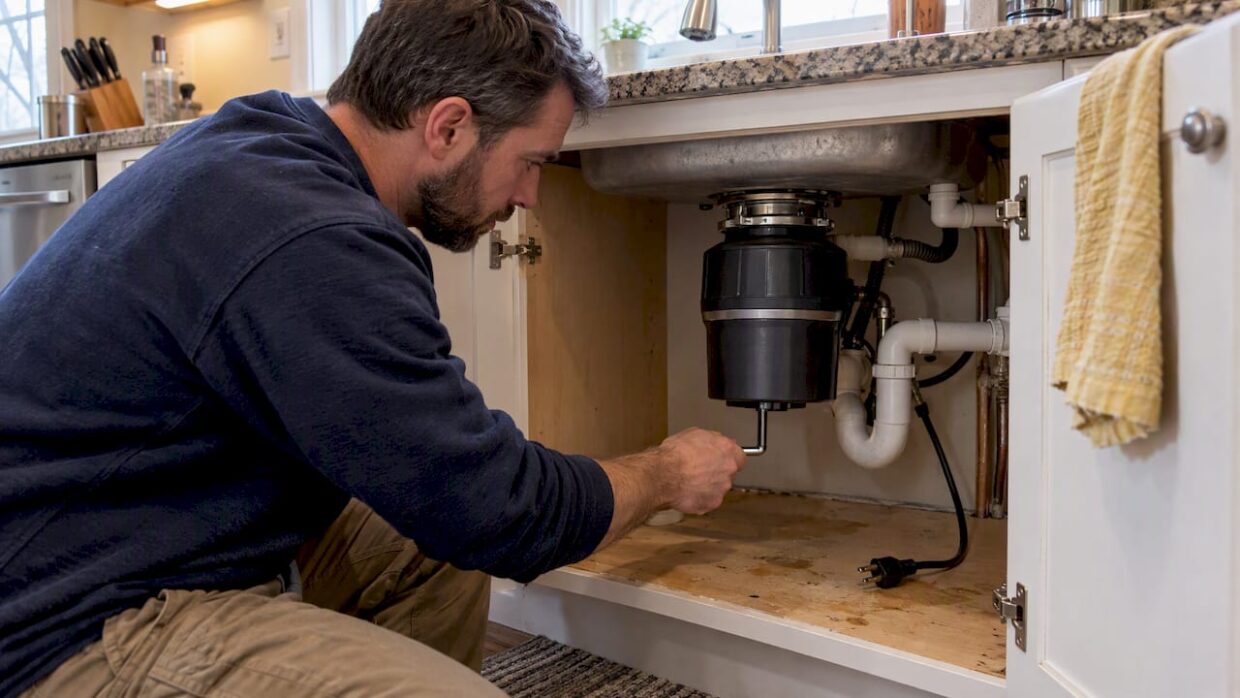
If your garbage disposal hums but doesn’t grind, it’s usually jammed. Cut the power, press the reset button, and manually free the flywheel using the bottom hex slot before testing again. If the breaker trips repeatedly, the reset won’t hold, or you notice smoke or a burning smell, stop and treat it as an electrical problem rather than a simple jam.
TL;DR:
- A humming disposal usually indicates a jammed flywheel, which can be cleared with a manual hex wrench turn and removal of the obstruction.
- Always disconnect power and wear safety gear before attempting repairs, and confirm the reset button is pressed and stays engaged after cooling down.
- Electrical issues are identifiable by complete silence, repeated breaker trips, or burning smells, requiring professional inspection instead of DIY fixes.
- Prevent jams by running cold water during operation, avoiding fibrous waste, and cleaning the chamber with ice and salt regularly.
- If DIY efforts fail or electrical problems arise, scheduling a professional repair typically provides a prompt fix with warranty coverage.
Table of Contents
- Safety checklist before you touch the disposer
- Fast checks: reset button, power, and visible foreign objects
- Step-by-step manual dejamming using the hex wrench
- How to recognize electrical or motor problems that need professional help
- Everyday habits and maintenance to reduce jams and humming
- When to stop DIY and what a service visit does
- How to schedule repair with Another Cycle Appliance Repair
- FAQ
- Sources
Safety checklist before you touch the disposer
Before you put a single tool near the unit, cut the power completely: flip the wall switch off, unplug the disposer if it’s cord-connected, or shut off the breaker for hardwired units. Never put your hand inside the grinding chamber, even with the power off. A flashlight, long-handled tongs, or needle-nose pliers keep your fingers away from the blades.
- Clear standing water from the sink before working underneath it.
- Wear eye protection in case debris flies loose when the flywheel releases.
- Keep children and pets away from the work area.
- Stop immediately if you see smoke, smell burning, notice leaks, or the reset doesn’t stay engaged.
Pro Tip: Tape over the switch or unplug the cord entirely rather than trusting the switch alone. It’s a two-second step that rules out an accidental restart while your hand is near the blades.
Fast checks: reset button, power, and visible foreign objects
Before reaching for tools, run through these quick checks in order.
- Locate the red reset button on the bottom of the unit and press it firmly.
- If it won’t stay in, give the motor time to cool. InSinkErator’s support guidance recommends waiting up to 20 minutes before trying again, since the overload protector trips to prevent motor damage and needs to cool before it will reset. Service-industry troubleshooting guidance similarly points to a 5 to 10-minute cool-down window as the usual fix for a reset that won’t hold.
- Confirm the wall switch is on, check that the outlet isn’t dead (test it with another small appliance), and look at your breaker panel for a tripped switch.
- Shine a flashlight down into the chamber and pull out any visible silverware, bones, or produce stickers with tongs.
- Run cold water before testing, and if the unit starts working, keep the water running for 15 to 60 seconds afterward to flush loose grease, following the flushing window Whirlpool recommends for continuous-feed disposers.
Step-by-step manual dejamming using the hex wrench
Most humming-without-grinding complaints trace back to a stuck flywheel, and clearing it by hand is usually straightforward once the power is confirmed off.
- Unplug the unit or switch off its breaker, and remove the sink stopper or splash guard if it’s in the way.
- Find the hex-shaped hole in the center of the bottom of the disposer and insert a disposal wrench (often included with the unit, or a standard 1/4-inch hex key).
- Turn the wrench back and forth firmly until you feel the flywheel break loose and spin freely, a method Maytag’s own troubleshooting instructions describe as the standard first step for a jammed disposer.
- From above, use tongs or needle-nose pliers to lift out whatever caused the jam. Glass shards, bottle caps, and fruit pits have sharp edges, so grip carefully and pull straight up.
- Some installers use a long-handled wooden spoon or a magnetic retrieval tool to fish out metal objects instead of reaching in with pliers; check your model’s manual since access points vary.
- Once the wheel spins freely and the obstruction is out, restore power, run cold water, press the reset button, and test the disposer briefly.
Martha Stewart’s appliance troubleshooting guide identifies a stuck flywheel as the most common cause of a humming disposal, which is why this manual method resolves the issue in most cases before any other diagnosis is needed. If the humming returns right away, power the unit down again rather than repeating the cycle, since that pattern often points to something beyond a simple jam.
How to recognize electrical or motor problems that need professional help
A mechanical jam hums because the motor is still getting power and trying to spin, a situation similar to issues covered in pool pump humming but not turning on. Electrical trouble often looks different: complete silence with no hum at all, a breaker that trips every time you flip the switch, or a reset button that pops back out again and again. Whirlpool’s own guidance draws this same line: humming with no rotation points to a mechanical jam, while silence or repeated breaker trips points to an electrical issue.
- No hum at all, even after confirming power at the outlet or breaker.
- Burning smell, visible arcing, or scorch marks near the wiring.
- A reset button that won’t hold even after a full cool-down period.
- For hardwired units, corroded wire-nut connections caused by under-sink moisture are a known failure point worth a professional inspection.
Hardwired accessories carry their own risks. The CPSC recalled InSinkErator’s SinkTop switch accessory after water entered the power module and created a fire hazard, a reminder that under-sink accessories can cause electrical problems unrelated to the disposer’s motor itself.
A disposer that spins briefly then stalls, or hums continuously without freeing up, often points to a failing motor capacitor or a seized bearing rather than a simple jam.
Everyday habits and maintenance to reduce jams and humming
Most humming calls are preventable with a few consistent habits.
- Run cold water before, during, and for 15 to 60 seconds after grinding so grease stays solid and flushes through instead of coating the pipes, per Whirlpool’s operating guidance.
- Keep bones, fruit pits, fibrous peels like celery or corn husks, and grease out of the disposer entirely.
- Clean periodically with ice cubes and coarse salt to scour the grinding chamber, and drop in small citrus peels for odor control.
- Skip caustic drain cleaners, which can damage internal seals and components over time.
- Check mounting hardware, hoses, and visible wiring occasionally for looseness, cracks, or leaks.
Pro Tip: Freeze a tray of vinegar-water ice cubes and run a batch through monthly. The ice scrubs the chamber walls while the vinegar cuts through grease buildup.
When to stop DIY and what a service visit does
Our technicians most often find seized flywheels, failed motors, or wiring corroded by years of under-sink moisture when a reset-and-dejam attempt hasn’t worked. If you’ve tried the hex wrench method and the humming keeps coming back, or you’re facing a tripped breaker, a leak, or any sign of electrical trouble, that’s the point to call for an inspection rather than keep testing it yourself.
We run a family-owned repair business built around clear pricing and straightforward advice about whether a unit is worth fixing or replacing. Our repairs typically include a warranty on parts and labor, and a diagnostic visit usually means a technician identifies the issue, explains the repair and cost upfront, and completes the repair in the same appointment.

How to schedule repair with Another Cycle Appliance Repair
When a disposer’s humming turns out to be a seized motor, failed capacitor, or corroded wiring instead of a quick jam, a same-visit fix beats another weekend of troubleshooting. We handle garbage disposal repair across Southern New Hampshire with upfront pricing and a one-year warranty on parts and labor, so you know the cost before work starts and you’re covered if anything needs a second look.
- Call or schedule service online to get a technician out for a diagnostic visit.
- Ask about our Platinum Appliance Care plan if you want routine maintenance across your kitchen appliances, not just a one-time fix.
- If you’re also dealing with issues on other appliances, our full service list covers refrigerators, dishwashers, washers, and more in one visit.
If your disposer trips the breaker, shows signs of electrical trouble, or just won’t free up after a few honest attempts, that’s the point where calling us saves you time and risk.
FAQ
My garbage disposal is humming and I press the reset button. What should I do?
If the reset button doesn’t stay in, wait before trying again rather than repeatedly forcing it. InSinkErator’s support page recommends waiting up to 20 minutes for the motor’s thermal overload to cool before resetting again. Once it holds, try the hex wrench method first in case a jam is also present.
Why is my garbage disposal humming even though it’s not clogged?
A humming sound with no visible food jam often points to a stuck flywheel that you can’t see from above, or a failing motor component like a capacitor or bearing. Troubleshooting guidance from Whirlpool suggests checking for an internal jam with a hex wrench before assuming the problem is electrical.
What can I pour down a garbage disposal to unclog it?
Garbage disposals clog mechanically, not chemically, so pouring liquid rarely fixes a jam. Ice cubes and coarse salt can help scour grease and debris loose during regular cleaning, but a jammed flywheel needs the hex wrench method, not a liquid treatment. Avoid caustic drain cleaners, which can damage the unit’s seals.
Why is my garbage disposal humming but not working?
Humming without grinding almost always means the motor has power but the flywheel can’t turn, usually because something is physically stuck. Maytag’s troubleshooting instructions walk through using a hex wrench in the bottom crank hole to free the wheel, which resolves this symptom in most cases.
Sources
- Operating a Continuous-Feed Waste Disposer | Whirlpool product help
- Clearing a jammed disposer | Maytag product help
- Resetting a garbage disposal | InSinkErator Support
- InSinkErator® Recalls SinkTop™ Switch Accessory for Garbage Disposals | CPSC
- Garbage disposal troubleshooting | ServiceMag