Nine times out of ten, a freezer that won’t freeze comes down to blocked airflow, frost buildup on the evaporator, an overloaded interior, or a dead fan or start relay. Check your temperature setting first. It should read at or near the target operating temperature for a home freezer, which is around 0°F (−18°C). Then run a quick checklist below before assuming you need a repair.
TL;DR:
- Most freezer cooling issues are caused by airflow blockages, frost buildup, or a failed fan, not system-wide failures.
- Overpacking beyond 60% capacity, internal vent obstructions, or frost on the evaporator can significantly hinder cooling performance.
- External factors like dust on coils or inadequate clearance behind and at the sides of the unit impair heat dissipation, reducing efficiency.
- Mechanical failures such as a dead evaporator fan or a faulty start relay are less common but require professional repair.
- Routine maintenance like cleaning coils and checking seals twice a year can prevent most cooling problems and extend the appliance’s lifespan.
Table of Contents
- Why Is My Freezer Not Cooling Properly? Run This Checklist First
- What’s Causing Your Freezer’s Cooling Problem?
- How to Fix a Freezer That Won’t Freeze
- Freezer Maintenance Tips to Prevent This From Happening Again
- A Technician’s Take on Freezer Troubles
- When to Call Another Cycle Appliance Repair
- Where to Verify Freezer Temperature Specs
- Sources
Why Is My Freezer Not Cooling Properly? Run This Checklist First
Grab a flashlight and give yourself 15 minutes. Most freezer temperature issues trace back to something you can spot without a single tool.
- Check the thermostat setting. It should be dialed to 0°F (−18°C). If it’s been bumped toward “warmer,” that alone can explain everything.
- Look at the internal vents. Food packages shifted in front of a vent will choke airflow instantly, even in an otherwise healthy unit.
- Estimate your fill level. If the freezer is packed past 60% capacity, air can’t circulate around the coldest points, and items up front never fully freeze.
- Run the dollar-bill test on the door seal. Close the door on a dollar bill halfway. If it slides out with no resistance, your gasket is leaking cold air.
- Check the condenser coils for dust and clearance. They need at least 4 inches of space behind the unit and 2 inches on the sides to shed heat properly.
- Listen. A running compressor with silence where a fan should be humming is a strong clue. Clicking that repeats every few seconds often points to a start relay.
Pro Tip: Put your ear against the freezer’s back panel for ten seconds before you touch anything else. A healthy unit hums low and steady. Clicking, buzzing, or dead silence tells you which section of this guide to read next.
What’s Causing Your Freezer’s Cooling Problem?
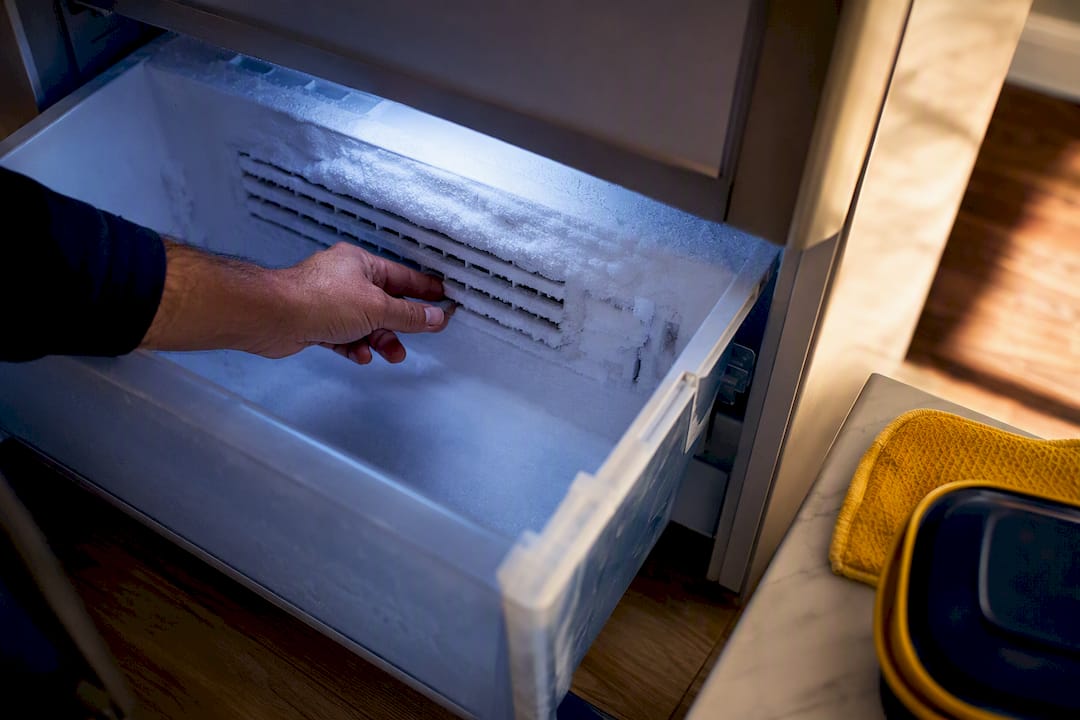
Airflow problems are the most common culprit, and they’re also the easiest to fix. Overpacking blocks the internal vents that push cold air around the cabinet, and a freezer stuffed with grocery hauls after a big shopping trip often can’t recover on its own. Frost buildup on the evaporator coil does something similar from the inside: once ice cakes over the coil, it can’t pull heat out of the air the way it’s designed to, and you’ll notice weaker airflow from the vents even though the compressor sounds fine.
Ventilation issues show up outside the cabinet. If the unit sits tight against a wall or is boxed into cabinetry without clearance, the condenser coils can’t dump heat, and the whole system works harder for less cooling. Dust-caked coils cause the identical symptom, which is why a coil check belongs early in any diagnosis.

Door seals fail quietly. A gasket that’s cracked, warped, or coated in old food residue lets warm air leak in continuously, and the compressor ends up running nonstop just to keep pace.
Mechanical and electrical failures are less common but more serious:
- A dead evaporator fan often leaves the compressor running normally while the cabinet stays warm. That mismatch, a working compressor with no cold output, is one of the more common signs to isolate an airflow failure from a sealed-system problem.
- A failing start relay causes repeated clicking as the compressor attempts and fails to start.
- A thermostat that’s stuck or miscalibrated can cause short cycling or a unit that never engages at all.
One statistic worth remembering: freezers are built to hold between −6°F (−21°C) and 6°F (−14°C) as an acceptable working range, with 0°F (−18°C) as the target. If your thermometer reads well above that range and stays there after basic fixes, you’re likely looking at a mechanical failure rather than a settings problem.
Warm cabinet walls, an oily residue near the compressor, or a freezer that stays warm no matter what you adjust point toward a sealed-system issue. That’s refrigerant-level territory, and it requires a certified technician, not a screwdriver.
How to Fix a Freezer That Won’t Freeze
Start with the safest, cheapest fixes and work your way up. Skip straight to a professional if you hit signs of electrical or sealed-system trouble.
- Power-cycle the unit. Unplug it for two minutes, plug it back in, and reset the thermostat to 0°F (−18°C).
- Reduce the load. Pull items away from vents and off door shelves, and move anything that needs to freeze fast toward the back wall, where the interior temperature runs coldest.
- Manually defrost a frosted evaporator. Unplug the unit, prop the door open, and let ice melt for several hours. A heavy frost layer is often mistaken for a cooling failure when it’s really just ice blocking airflow.
- Clean the condenser coils. Unplug the unit first. Use a coil brush or vacuum attachment to clear dust, and confirm you’ve restored that 4-inch rear and 2-inch side clearance.
- Check the drain line for ice clogs if you notice water pooling at the bottom of the cabinet.
- Rule out the outlet. Confirm the freezer runs on a dedicated circuit and the outlet hasn’t tripped on a GFI before you blame the appliance itself.
Pro Tip: Write down what you hear and see before calling for service: whether the fan spins, whether the compressor clicks or runs continuously, and how warm the cabinet feels. That handful of details lets a technician often diagnose the issue before even opening the panel.
Stop the DIY approach and call a professional if you notice a seized or silent evaporator fan, a compressor that clicks repeatedly without starting, or persistent warm temperatures after you’ve tried everything above. Sealed-system work involves refrigerant and specialized tools, and it’s not a safe or legal DIY repair.
Whatever you fix, give the unit up to 24 hours to stabilize before checking the temperature again. Freezers recover slowly, and judging success after just an hour or two will make a working fix look like a failure.
Freezer Maintenance Tips to Prevent This From Happening Again
A few minutes twice a year saves you from most of the failures above. Clean the condenser coils every six months, and check the door gasket quarterly for cracks or gaps using the dollar-bill test.
- Keep the freezer at or under 60% capacity so vents stay clear and air keeps circulating.
- Maintain some clearance behind and on the sides of the unit for proper heat dissipation.
- Avoid tight built-in installations without dedicated ventilation space.
- After any power outage or after moving the unit, give it a full 24 hours before judging its performance.
- Book a routine maintenance visit periodically. A technician catches a weakening fan motor or a fatigued relay months before it fails outright.
If drafts around your kitchen or utility space are part of the problem, sealing gaps near doors and windows helps keep ambient temperatures more stable, which takes some of the strain off the compressor. One Day Doors & Closets has a solid rundown on winterizing doors that pairs well with freezer maintenance.
A Technician’s Take on Freezer Troubles
After nearly 20 years fixing appliances across Southern New England, the pattern repeats: a freezer that “just stopped cooling” almost always turns out to be a fan quietly failing while the compressor keeps running, tricking homeowners into thinking the whole unit is dying. One quick tip: if the compressor’s warm but the air isn’t moving, suspect the fan before anything else.
— Rich
When to Call Another Cycle Appliance Repair
Book a technician once you’ve ruled out the easy fixes and you’re still staring at a warm freezer, especially if you’ve noticed a seized fan, a compressor that clicks but won’t start, or temperatures that stay high 24 hours after your last adjustment. Those symptoms usually mean sealed-system or electrical component work, and that’s not a safe DIY zone.
Another Cycle Appliance Repair handles in-home freezer repair across Southern New Hampshire, including integrated units through refrigerator repair service, with a one-year warranty on parts and labor. When you book, have your model number ready and a quick note on what you heard or saw during your own checks. A technician will diagnose the issue, walk you through the repair cost before starting, and work to get the unit running again quickly. Check the full lineup of appliance repair services or schedule a visit directly to get your freezer back on track.

Where to Verify Freezer Temperature Specs
For model-specific troubleshooting, check your manufacturer’s support page. GE Appliances and Maytag both publish detailed guidance on target temperatures and common failure points. Sealed-system repairs always require a certified technician.
Sources
- GE Appliances support: Freezer operating temperatures
- LG support: Refrigerator/freezer not cold enough — common causes
- Maytag — Why Is My Freezer Not Freezing?