Clean or inspect your dryer vent at least once a year, and do it sooner if you notice longer drying times, excessive lint, a dryer that feels hot to the touch, or a blocked exterior flap. This baseline reflects guidance from the National Fire Protection Association, USFA, and CPSC, and it’s the same standard Another Cycle Appliance Repair applies when inspecting vents for homeowners.
TL;DR:
- Regularly inspect and clean your dryer vent at least once a year, or more often if you have heavy use, pets, or long duct runs.
- Warning signs like longer drying times, excess lint, hot exterior, or weak airflow indicate immediate vent blockage requiring prompt cleaning.
- Duct material, length, and household habits significantly influence how frequently you should clean, with longer or more flexible ducts needing more frequent attention.
- Professional cleaning involves comprehensive inspection of all vent parts, often using cameras and specialized tools, and typically takes 30 to 90 minutes.
- Basic maintenance such as cleaning the lint filter and exterior vent is easy to do yourself and can extend the interval between professional cleanings.
Table of Contents
- What’s the right cleaning schedule for your household?
- Signs your dryer vent needs cleaning now
- What changes how often you need to clean
- What a professional dryer vent cleaning actually covers
- Simple maintenance you can do between cleanings
- Time and cost expectations: DIY vs. professional service
- How we think about dryer vent maintenance
- Book a dryer vent cleaning with Another Cycle Appliance Repair
- Where this information comes from
- Sources
- FAQ
What’s the right cleaning schedule for your household?
Annual cleaning works as a default for most households, but your actual schedule depends on how hard your dryer works and how your vent system is built.
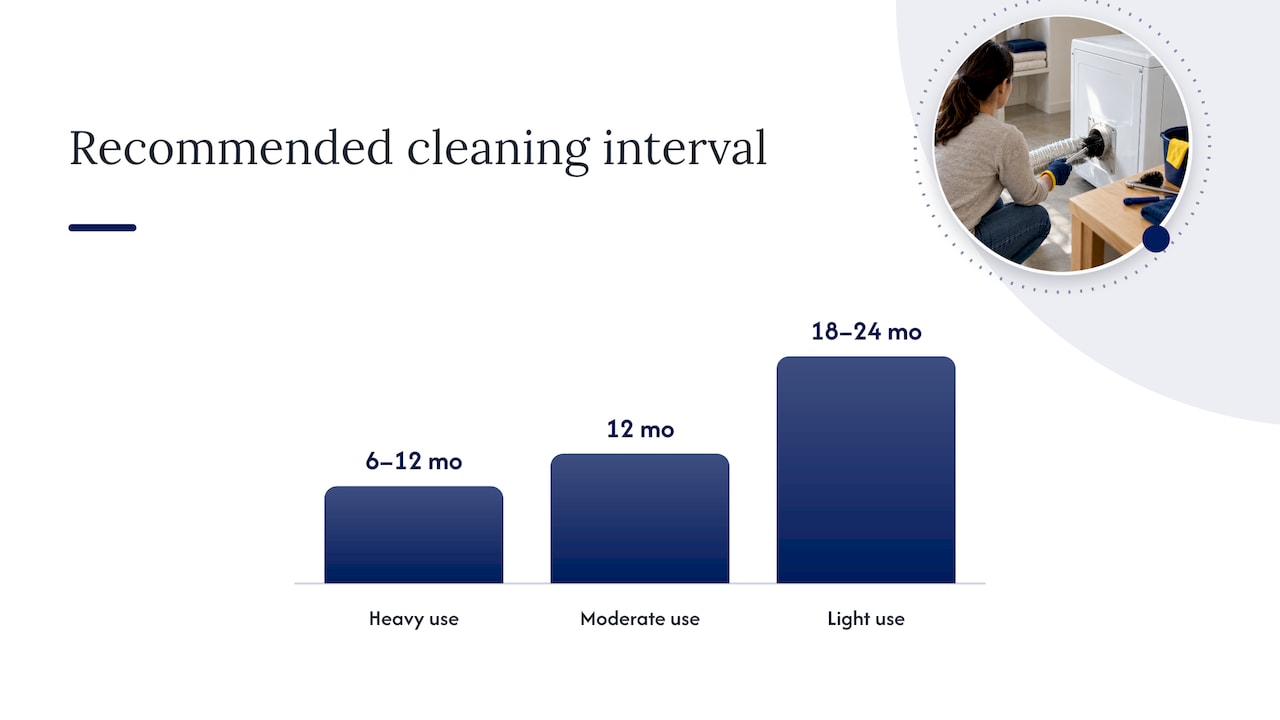
Households running a load or two most days, with pets shedding fur, or with long duct runs should move to a 6 to 12 month schedule. Lint builds up faster when there’s more volume going through the system and more surface area for it to catch on. On the other end, a household with light use, short straight ducts, and no pets can often stretch to 18 to 24 months, as long as nothing looks or feels off in the meantime.
Use this quick checklist to find your bracket:
- Heavy use (6 to 12 months): daily or near-daily loads, pets in the home, or a long duct run with multiple bends.
- Moderate use (annual): a typical family doing several loads a week with a straightforward, shorter duct run.
- Light use (18 to 24 months): one or two people, occasional loads, and a short, mostly straight vent path.
Whatever bracket fits, that schedule only holds if you’re also watching for warning signs between cleanings.
Signs your dryer vent needs cleaning now
Some symptoms mean you shouldn’t wait for the calendar. If you notice any of the following, treat it as a signal to act right away rather than sticking to your usual schedule.
- Clothes take noticeably longer to dry, or you’re running a second or third cycle to finish a load that used to dry once.
- You’re pulling more lint than usual off the screen, or you spot lint collecting around the dryer door seal or cabinet.
- Lint is visible at the outside vent opening, sometimes clumped right at the termination point.
- The dryer feels hotter than normal on the outside, or you catch a burning smell during a cycle.
- The exterior flap doesn’t open on its own when the dryer runs, or airflow at the outside vent feels weak when you hold your hand near it.
Any one of these points to restricted airflow somewhere in the system. CPSC testing on dryer lint accumulation found that lint builds up inside the dryer chassis and exhaust path even when the lint screen gets cleaned regularly, which is why a clean screen alone doesn’t rule out a blocked vent.
What changes how often you need to clean
Not every dryer vent setup carries the same risk, and a few structural and lifestyle factors shift the right frequency for your home.
- Duct length and bends: longer runs and more turns give lint more places to snag and give moisture more chances to condense, so USFA’s analysis of dryer fires flags long or flexible duct runs as a recurring factor in fire incidents.
- Gas dryers: beyond vent cleaning, gas units benefit from an annual professional check of the gas connection, since a leak or loose fitting is a separate hazard from lint buildup.
- Duct material: rigid metal duct sheds lint more easily than plastic or foil, which trap it in ridges and folds.
- Household habits: pets, frequent towel or blanket loads, and back-to-back drying cycles all add lint volume faster than average use.
If two or more of these apply to your home, lean toward the shorter end of your usual cleaning interval.
What a professional dryer vent cleaning actually covers
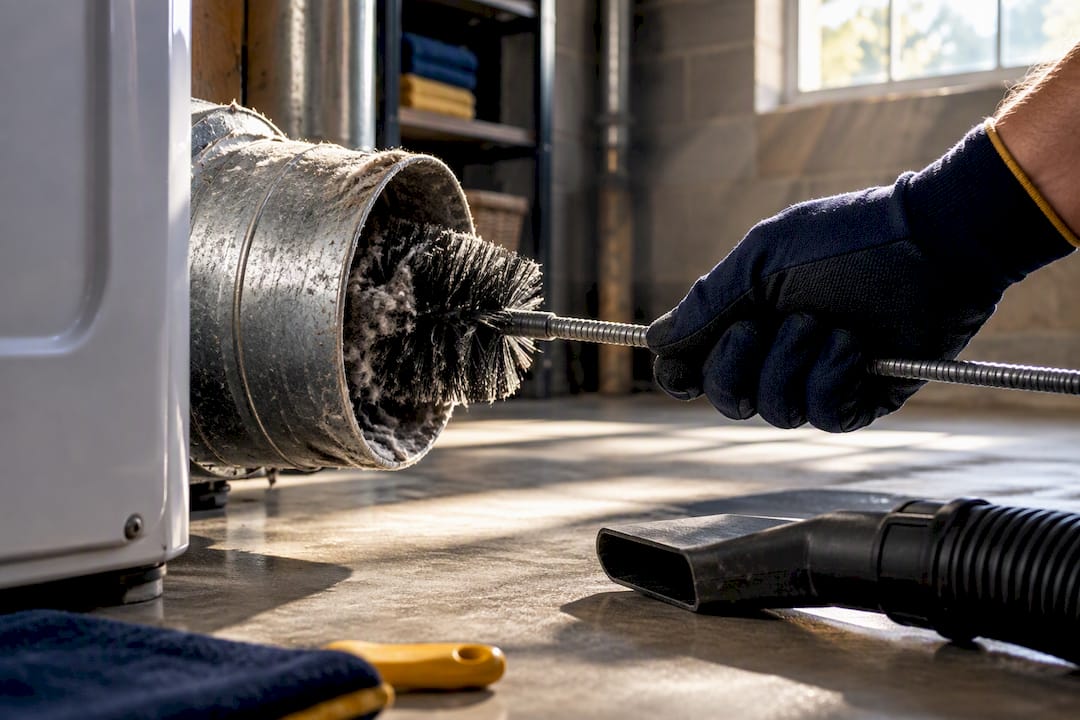
A thorough professional visit goes well past what you can see by pulling the dryer away from the wall. A technician typically checks the lint screen and housing, the interior cabinet, the transition connector behind the dryer, the full duct run, and the exterior termination, often using a camera to inspect sections that are boxed in or run through multiple floors.
The tools matter here. Rotary brushes and high-powered vacuums clear packed lint that a household vacuum can’t reach, and a camera confirms the duct is actually clear end to end rather than just clean at the visible ends.
Call a professional when:
- Drying times stay long even after you’ve cleaned the lint screen and checked the exterior flap.
- You can see or feel a blockage but can’t reach it yourself.
- Sections of the duct run are hidden behind walls, ceilings, or tight spaces.
- You have a gas dryer and want the connection checked along with the vent.
- You notice scorch marks, melted duct material, or other signs of past overheating.
A typical professional dryer vent visit runs 30 to 90 minutes, with the exact time depending on how accessible the duct is and how much buildup has to come out.
Simple maintenance you can do between cleanings
You don’t need a technician for everything. A few habits, done consistently, cut down how much lint accumulates and how often you need a full professional cleaning.
- Clean the lint filter before and after every load, and wash it with warm water every one to three months to clear the residue that regular wiping misses.
- Check the rear connector and exterior vent visually every six to twelve months, and clear any debris, leaves, or nests from the outdoor flap.
- Swap out flexible plastic or foil ducting for rigid, smooth metal wherever your setup allows it, since smooth walls give lint less to grab onto.
- Never attempt gas-line work yourself, and don’t run the dryer if you already know the vent is blocked.
Pro Tip: Keep a small brush and a flashlight near the dryer so checking the lint trap and connector takes thirty seconds instead of becoming a chore you put off.
Time and cost expectations: DIY vs. professional service
DIY maintenance costs you almost nothing beyond a few minutes per month, and it’s the right call for the lint screen and a visual check of the exterior flap. A full duct cleaning is a different matter: professionals typically spend 30 to 90 minutes on site, with time and cost driven by how accessible the duct is, how long the run is, how severe the clog is, and whether a gas-safety check is included. Skipping a professional cleaning to save money can turn into a false economy once it costs you in energy bills or a service call for a dryer that’s stopped heating properly.

How we think about dryer vent maintenance
After many years repairing appliances, we’ve learned that most dryer problems people face start upstream, in a vent nobody’s checked in years. When servicing a dryer, it’s important to look at the whole exhaust path, not just the machine, which is why routine vent checks are often included in maintenance plans rather than treated as an afterthought. A vent that’s actually clear saves you a repair call later.
— Rich
Book a dryer vent cleaning with Another Cycle Appliance Repair
If you’re seeing any of the warning signs above, running a gas dryer, or dealing with a long or oddly routed duct run, it’s worth having a professional look before the vent turns into a bigger problem. Another Cycle Appliance Repair handles dryer vent cleaning alongside dryer repair for homeowners across Southern New Hampshire, backed by a one-year warranty on parts and labor.
For ongoing coverage instead of a one-time visit, the Platinum Appliance Care plan bundles routine inspections, including vent checks, for $549 one-off. Whether you need a single cleaning or want your dryer on a regular schedule, you can see the full range of services and book directly through our services page.
- Transparent pricing to avoid surprise fees.
- Warranty coverage for parts and labor on repair work found during inspection.
- Scheduling that serves the local area, with prompt communication from booking to completion.
Where this information comes from
- USFA Topical Fire Report: Clothes Dryer Fires
- USFA statistics on residential dryer fires
- CPSC lint accumulation testing
- RealSimple: lint trap and vent cleaning guidance
- Martha Stewart: how to clean dryer vents
Sources
- Request from McDowell Owens Engineering, Inc. and CPSC response — Lint accumulation testing
- Topical Fire Report Series: Clothes Dryer Fires in Residential Buildings (2008-2010)
- USFA statistics reports — Clothes dryer fires in residential buildings
- How Often Should You Clean Your Dryer’s Lint Trap? What Appliance Experts Want Everyone to Know — RealSimple
- How to clean dryer vents — Martha Stewart
FAQ
What happens if you never clean your dryer vent?
Lint keeps building inside the duct and dryer chassis until airflow is severely restricted, which raises the dryer’s internal temperature and its fire risk. USFA’s analysis of dryer fires identifies failure to clean vents as a frequent factor in these incidents, alongside longer drying times and higher energy use.
How do you know if your dryer ducts need cleaning?
Watch for longer drying times, heavy lint around the door seal or cabinet, a dryer that runs hotter than usual, or a weak airflow and stuck flap at the outside vent. Any of these signs means it’s time to check the duct, even if you’re not due for your regular cleaning yet.
How long does it take a professional to clean a dryer vent?
Most professional visits take 30 to 90 minutes, depending on how accessible the duct is and how much lint has built up. Longer or more complex duct runs, or ones requiring a camera inspection, tend to fall toward the higher end of that range.
What are the common dryer vent cleaning mistakes?
The most common mistake is assuming a clean lint screen means the whole system is clear, when lint can still accumulate deeper in the chassis and duct. Other frequent errors include using flexible plastic or foil ducting, ignoring the exterior flap, and running the dryer despite a known blockage.
Do ventless or condenser dryers need vent cleaning too?
Ventless and condenser dryers don’t exhaust to the outside, so they skip the duct-cleaning schedule altogether, but they still need regular filter and condenser cleaning to keep airflow clear inside the unit. Check the owner’s manual for the recommended interval, since it varies by model and how often the dryer runs.