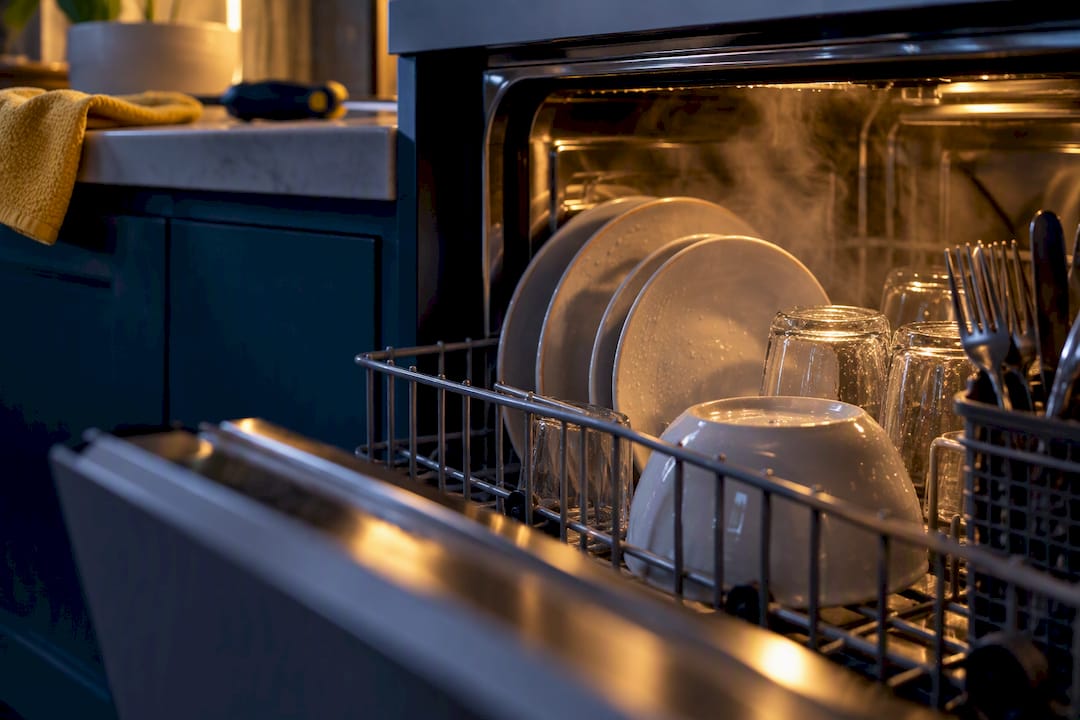
Most dishes come out wet because the rinse aid dispenser is empty, the wrong cycle is running, or plastics and nested bowls are trapping water. Check rinse aid first, switch to Heated Dry or Sanitize, and fix your loading pattern before assuming anything is broken. If the tub still isn’t warm after a Sanitize cycle or a power reset, you’re likely looking at a heating element, thermostat, or vent problem that needs professional service.
TL;DR:
- Properly refilling the rinse aid and choosing Heated Dry or Sanitize cycles are essential steps before suspecting a hardware failure.
- If dishes remain wet after troubleshooting rinse aid and loading, testing the heating element and vent with a power reset and cycle is the next logical step.
- Water temperature should be around 120°F for optimal drying, and mineral buildup from hard water can be mistaken for a heating component problem.
- Monthly maintenance of filters, spray arms, and descaling is necessary to maintain drying performance over time.
- Most drying failures are caused by rinse aid neglect, low water temperature, or loading errors, with hardware issues being less common but requiring professional diagnosis.
Table of Contents
- Quick Checks to Try Right Now: Rinse Aid, Cycle, and Loading
- How to Test the Heating Element, Vent, and Controls Safely
- Water Temperature and Residue: Why Hot Fill and Descaling Matter
- Monthly Maintenance Checklist to Keep Drying Performance Consistent
- When to Call a Technician and What Information Speeds Diagnosis
- What Technicians See in the Field on Drying Complaints
- Schedule an In-Home Dishwasher Diagnostic
- Manufacturer Resources for Model-Specific Troubleshooting
- Sources
- FAQ
Quick Checks to Try Right Now: Rinse Aid, Cycle, and Loading
Before you touch a screwdriver or call anyone, run through the checks manufacturers put at the top of every troubleshooting list. Rinse aid neglect is one of the most common reasons dishes come out spotted or wet, because rinse aid breaks the surface tension of water so it sheets off dishes instead of clinging as droplets. Without it, even a healthy machine leaves streaks and puddles.
Work through these before anything else:
- Open the rinse aid dispenser and refill it if the indicator shows empty or low.
- If you have hard water, bump the dosage up a notch. The dispenser typically holds a small amount and lasts several weeks to a few months, so raise it gradually rather than maxing it out at once.
- Confirm you’re running Heated Dry, Extra Dry, or Sanitize. Eco and Air Dry cycles save energy by skipping the heat boost, which is great for your utility bill and terrible for wet bowls.
- Reload smarter: don’t nest bowls or cups together, angle concave items downward so water can’t pool, keep plastics on the top rack away from the heating element, and stagger flatware instead of bunching handles together.
- Let the bottom rack drain first when unloading, since water collects there and drips onto whatever’s below.
Pro Tip: Crack the door two or three inches right after the cycle ends, if your owner’s manual allows it. That short burst of venting lets trapped steam escape before it condenses back onto your dishes as moisture.
How to Test the Heating Element, Vent, and Controls Safely
If rinse aid and loading fixes don’t solve why your dishwasher isn’t drying, the next step is a controlled hardware check you can do yourself in about 15 minutes.
Power-cycle the unit. Flip the breaker off for a full minute, then restore power. This clears minor control-board glitches that can quietly disable the heating element, and it’s the first step Whirlpool’s own repair guidance recommends before assuming a part has failed.
2. Run a Sanitize cycle or a 1-hour cycle with Heated Dry. A functioning heating element brings the tub to a specific temperature threshold during Sanitize, and the Sanitize indicator light should glow steady when it succeeds.
3. Feel the tub and dishes at the end. Warm, faintly steamy dishes mean the element and thermostat are doing their job. A cool, dry-feeling tub points to a heating or control fault.
4. Watch and listen for vent activity. A working vent fan hums quietly near the end of the cycle as it pushes moist air out. No sound, a door that stays fogged, or steam that lingers inside the tub for many minutes after the cycle ends usually signals a stuck or failed vent motor.
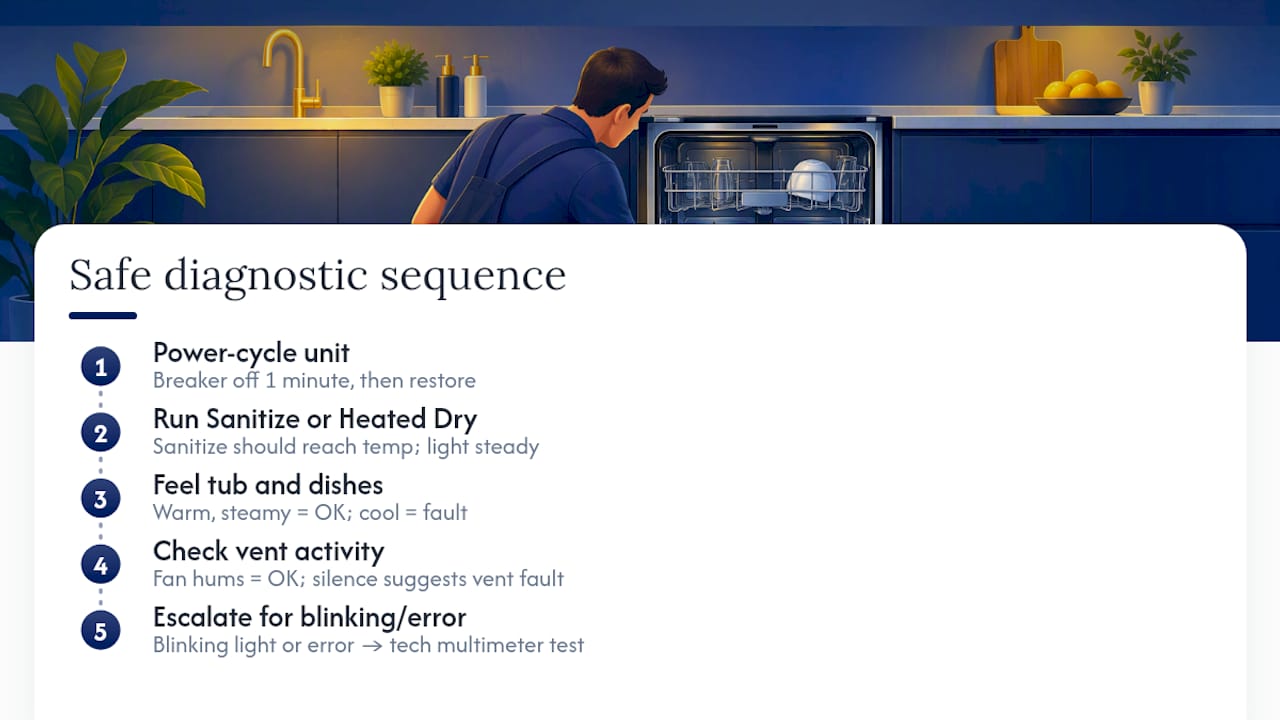
If the Sanitize light blinks instead of holding steady, or if an error code returns after the power reset, manufacturer guidance from GE Appliances points to the same conclusion: the heating element, high-limit thermostat, or vent assembly needs a technician’s multimeter test, not more guesswork at home.
Water Temperature and Residue: Why Hot Fill and Descaling Matter
A dishwasher running on lukewarm water can’t dry dishes well no matter how good the rinse aid is, because heat is what drives evaporation. Manufacturer guidance recommends about 120°F (49°C) at the kitchen tap for the best combination of wash performance and drying. Run your hot water for 30 to 60 seconds and check it with an ordinary kitchen thermometer under the tap.
Cloudy glasses and a chalky film often get blamed on a broken heating element when the real culprit is mineral buildup. A simple vinegar test settles the question: soak a cloudy glass in white vinegar for a few minutes, and if the film dissolves it’s limescale from hard water, not permanent glass etching, which vinegar won’t touch.
- If the vinegar test confirms limescale, run a dishwasher cleaning cycle with a descaling product before you touch rinse aid settings again.
- Adjust your rinse aid dose in small increments and give it a full cycle or two to judge the result.
- If your water heater is set below 120°F, raising the thermostat a few degrees is a homeowner-level fix.
- If dishes stay lukewarm even with the water heater turned up, that points to an internal thermostat problem a technician needs to inspect.
Pro Tip: Keep a small jar of white vinegar near the dishwasher. It’s the fastest, cheapest way to rule out hard water before you start swapping parts.
Monthly Maintenance Checklist to Keep Drying Performance Consistent
A dishwasher that dries perfectly for two years and then suddenly doesn’t usually needs cleaning, not repair. Build these four habits into a monthly routine:
- Pull and rinse the filter. Most bottom-rack filters twist out by hand; rinse off trapped food particles under the faucet so water can drain and evaporate properly.
- Clear the spray arms. Spin each arm and clear any clogged holes with a toothpick, since blocked jets reduce both wash and final-rinse temperature.
- Run a monthly descale cycle in hard-water areas. Use a dedicated descaling product on an empty cycle, and never mix it with regular detergent in the same run.
- Check the rinse aid dispenser after a cycle. The fluid level should visibly drop each time the machine runs; if it never moves, the dispenser cap or wax motor may be stuck.
Even with perfect maintenance, expect plastic containers to stay damp longer than glass or ceramic. Plastic holds less heat and cools fast, so a few water droplets on your food storage lids after a cycle is normal, not a sign your machine is failing.
When to Call a Technician and What Information Speeds Diagnosis
Call for professional service if the power reset doesn’t help, the tub stays cool after a full Sanitize cycle, error codes keep returning, or the vent and door mechanism looks physically damaged. These are hardware failures, not settings problems, and pushing more cycles through the machine won’t fix them.
Before the technician arrives, gather:
- Model and serial number, usually printed on a sticker inside the door frame.
- Which cycle and options you were using when you noticed the problem.
- The tap water temperature you measured, if you tested it.
- A short list of what you already tried, including the power reset and rinse aid check.
A technician typically confirms the diagnosis with a multimeter test on the heating element, a continuity check on the high-limit thermostat, and a physical inspection of the vent motor. Pro Tip: Take a phone photo of the model and serial number sticker the moment you notice a problem. It saves time later and means you won’t be crouched under the machine reading tiny print while someone’s on hold.
Most drying failures turn out to be a single failed part, like a heating element or thermostat, rather than a full control-board replacement. That distinction usually decides whether the repair costs far less than a new dishwasher or starts to approach it, which is exactly the repair-or-replace conversation worth having with your technician before work begins.
What Technicians See in the Field on Drying Complaints
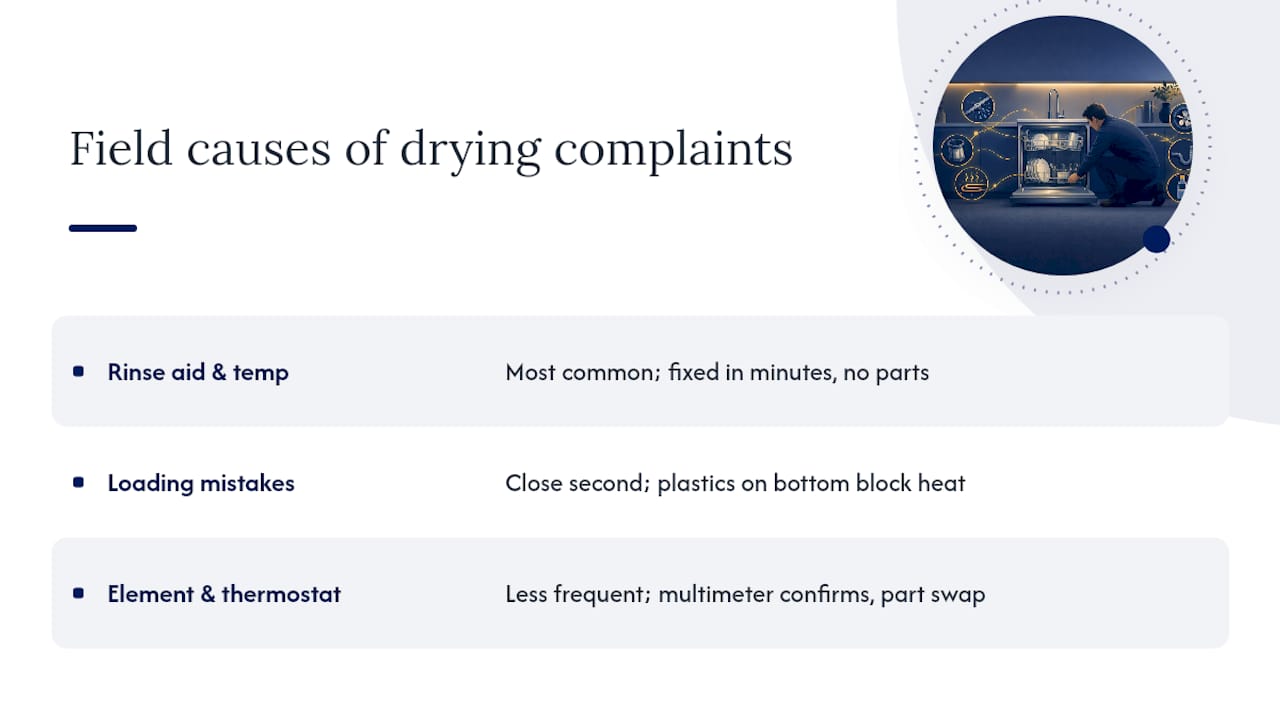
Rinse aid neglect and low tap temperature account for the bulk of “my dishwasher won’t dry” calls we see, and both get fixed in minutes with no parts involved. Loading mistakes come in a close second, especially plastics crammed onto the bottom rack where they block the element’s heat.
True heating element and thermostat failures are real but less frequent than homeowners expect, and they show up as a consistent pattern: cool tub, no steam, every single cycle regardless of settings. When that pattern holds after a power reset and a Heated Dry test, a multimeter on the element almost always confirms the fault, and the fix is usually a straightforward part swap rather than a major overhaul. The homeowners who get the fastest, cheapest fix are the ones who rule out rinse aid and water temperature themselves first, then call before guessing at parts.
— Rich
Schedule an In-Home Dishwasher Diagnostic
If you’ve worked through the rinse aid, cycle, and vent checks and your dishes are still coming out wet, it’s time for a real diagnosis instead of another round of guessing. Technicians can be sent directly to your home to test the heating element, thermostat, and vent motor with professional tools, and repairs often include a warranty on parts and labor. Current pricing details are available on the company’s website before any work starts.
Have your model and serial number, the cycle you were running, and a quick rundown of what you’ve already tried ready when you call. Many drying complaints get resolved in a single visit once the technician confirms the part. You can review the dishwasher repair service details or book directly through online scheduling to get a technician on the calendar.
Manufacturer Resources for Model-Specific Troubleshooting
For guidance specific to your machine, manufacturer pages beat generic advice every time. Whirlpool’s drying performance guide covers rinse aid and dispenser checks in detail, Bosch explains how condensation-dry models maximize evaporation, and GE Appliances lays out its full drying troubleshooting checklist for scheduling factory service when DIY checks come up empty.
Sources
- Why is my dishwasher not drying? | GE Appliances Factory Service
- Tips to maximize drying | Bosch Home
FAQ
How do you fix a dishwasher that is not drying?
Start by refilling the rinse aid dispenser and switching to Heated Dry, Extra Dry, or Sanitize instead of an Eco cycle. If dishes are still wet after fixing loading and running a full Sanitize cycle, test the heating element with a power reset first, then schedule service if the tub stays cool.
Why is my dishwasher not drying like it used to?
A machine that used to dry well and suddenly doesn’t has usually developed a maintenance issue, not a design flaw. Clogged filters, worn spray arm jets, and a rinse aid dispenser that’s stopped releasing fluid properly are the most common causes, and mineral buildup from hard water can mimic the same symptom.
Why is my dishwasher still wet after drying?
Lingering moisture after a full cycle usually traces back to low rinse aid, a cycle setting without heat boost, or dense loading that traps steam between dishes. Plastic items commonly stay damp even in a properly working machine because plastic retains far less heat than glass or ceramic.
How do I know if my dishwasher heating element is bad?
Run a Sanitize or one-hour cycle with Heated Dry and check the tub immediately afterward. A working element leaves the tub distinctly warm and slightly steamy; if it feels cool and dry with no steam and the sanitize light blinks instead of holding steady, the element or its thermostat has likely failed and needs professional testing.