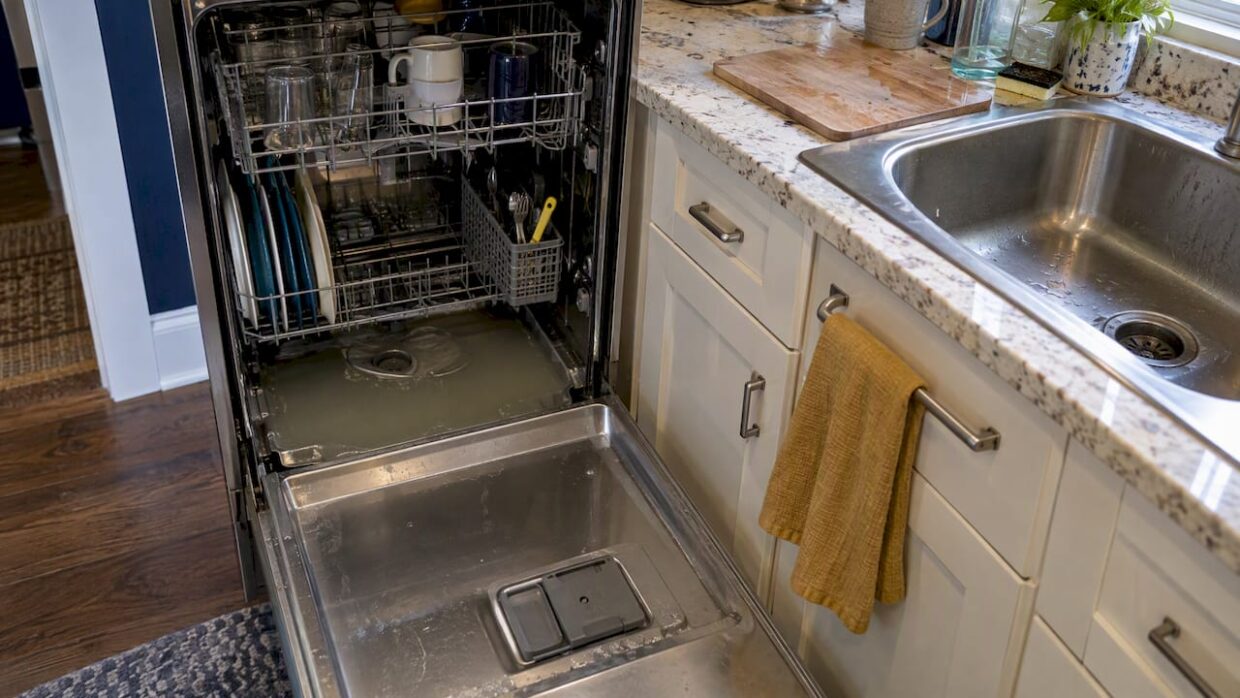
A dishwasher that leaves a pool of dirty water in the tub is, most of the time, blocked somewhere along the drain path: the filter, the sump, the garbage disposal connection, the air gap or the drain hose. Those are all things you can check yourself in under an hour with a flashlight, a towel and a few basic tools. If none of them is the culprit, the problem is usually the drain pump or the control board, and that is the point to stop and call a technician.
This guide walks through the checks in the order that saves the most time, tells you what not to do, and explains what a professional repair typically costs so you can decide when a service call is the smarter move.
TL;DR
- Start with the simple things: turn off power, bail out the water, and clean the filter at the bottom of the tub. A clogged filter is the most common cause.
- Next check the garbage disposal knockout plug, the air gap, the high loop and the drain hose for kinks. All of these can stop water from leaving.
- Never put drain cleaner in a dishwasher and never reach your bare hand into the sump, where broken glass can hide.
- If the water still won’t leave after the filter, hose and disposal are clear, or you hear a humming pump or see an error code, the pump or controls are likely at fault. That is a job for a technician.
- A typical professional drain repair runs roughly $100 to $300 nationally, and more if the pump has to be replaced.
Table of Contents
- First, confirm it’s really a drain problem
- Safety before you start
- Fix 1: Clean the filter
- Fix 2: Check the garbage disposal connection
- Fix 3: Clean the air gap
- Fix 4: Inspect the drain hose and high loop
- Fix 5: Look at the kitchen sink drain
- What not to do
- If everything is clear and it still won’t drain
- When to stop and call a professional
- What does it cost to fix a dishwasher that won’t drain?
- Our perspective: what we see in Southern New Hampshire kitchens
- Need a hand? Here’s how we help
- Keep it from happening again
- FAQ
- Sources
First, confirm it’s really a drain problem
Before you pull anything apart, rule out the easy false alarms.
- A little water at the bottom is normal. Many dishwashers leave a small amount of water in the sump between cycles. A shallow film is not a fault. Water covering the bottom of the tub, or sitting above the filter, is.
- Run the cancel or drain cycle. Most models have a Cancel/Drain option, or you can press Cancel for a few seconds. Give it a couple of minutes to see if the pump kicks in.
- Look at the sink. If the kitchen sink is backing up too, or the other side of a double sink fills when the dishwasher runs, the problem is in the household drain or disposal, not the dishwasher.
- Check for a code. Flashing lights or a code on the display can point straight at a drain fault. Our guide to flashing dishwasher lights explains when a code means you should stop DIY.
If the tub is still holding water, move on.
Safety before you start
Two minutes of preparation prevents most injuries and messes.
- Cut the power. Whirlpool advises emptying the unit and disconnecting it from its power source before you troubleshoot a drain problem. Flip the dedicated breaker or unplug it if you can reach the cord.
- Remove the standing water. Use a cup and a small bowl, then soak up the rest with a towel or a wet-dry vacuum. Dirty water is greasy, so lay down a towel to protect your floor.
- Pull out the bottom rack. This gives you access to the filter, spray arm and drain area.
- Protect your hands. Martha Stewart’s guidance is to never reach into the sump with bare hands, because sharp edges or broken glass can hide where you can’t see. Wear thick gloves and use a flashlight.
Fix 1: Clean the filter
If there is one place to start, this is it. Food, grease, paper labels and bits of glass collect in the filter assembly at the bottom of the tub, and when it clogs, water cannot get to the pump.
How to do it:
- Locate the filter under the lower spray arm. Many are a cylinder you twist counterclockwise to release; some have a flat mesh screen under the cylinder.
- Lift the pieces out and look for slimy buildup, seeds, pasta, eggshell, toothpicks or glass.
- Rinse the parts under warm running water. Whirlpool recommends a soft brush such as an old toothbrush and warns against abrasive materials that can damage the fine mesh.
- With the filter out, look into the sump below it with a flashlight. Remove any loose debris you can see, using tongs or a gloved hand only if you can see that nothing sharp is in the way.
- Reinstall the filter fully and lock it. A filter that is not seated correctly can cause new problems.
How often should you do this? On models with a manual filter, Consumer Reports says to clean it about once every couple of months by removing the bottom rack, taking the filter apart and rinsing each piece at the sink. If you rarely scrape plates, do it more often.
Fix 2: Check the garbage disposal connection
In many kitchens the dishwasher drains through the garbage disposal, or through a drain line that joins the disposal. A packed disposal means the dishwasher has nowhere to send its water.
- Run the disposal. Turn on the cold water and run it for 15 to 20 seconds to clear what’s inside. If it hums but doesn’t spin, it’s jammed and needs its own fix.
- Check the knockout plug on a new disposal. This is a classic problem after a disposal is replaced. The dishwasher inlet on a new unit has a small plastic plug that must be knocked out. If the installer left it in place, the dishwasher can’t drain at all. With the power off and the disposal unplugged or the breaker off, you can look into the inlet and remove the plug with a screwdriver and a hammer, then fish out the piece.
- Clear the inlet. Even without a plug, the dishwasher port on the disposal can fill with ground food. Disconnect the drain hose, check the port and clean it out.
If the disposal itself is the problem, we cover that on our services page, which lists garbage disposal repair alongside our other appliance work.
Fix 3: Clean the air gap
Some homes, especially where local plumbing codes call for it, have an air gap: a small cylinder mounted on the sink deck or countertop near the faucet. It sits between the dishwasher and the drain to keep dirty water from flowing back into the dishwasher. When it fills with debris, the dishwasher drains slowly or not at all, and you may see water bubble out of the air gap during a cycle.

To clean it, pop off the cover and clear what’s inside with tweezers or a narrow brush. The Washington Post describes cleaning the air gap by removing the cover and clearing debris, or by blowing through the mechanism with a tube. Rinse the cap before putting it back.
Not every home has an air gap. If yours doesn’t, the drain hose should have a high loop instead, which is the next thing to check.
Fix 4: Inspect the drain hose and high loop
The drain hose runs from the dishwasher pump to the disposal or the sink drain pipe. It’s usually a ribbed, flexible hose, and it can fail in a few ways.
- Kinks. If the dishwasher was pushed back into its space after a new floor or cabinet went in, the hose may be pinched behind it. Whirlpool says to check drain hoses for kinks or improper installation, which can prevent the dishwasher from draining.
- Missing high loop. Samsung notes that a dishwasher may not drain because the sink drain is blocked or the hose is kinked, improperly connected, or lacks a high loop or air gap. The high loop is the hose looped up toward the underside of the countertop and secured before it runs down to the drain. It keeps sink water from running back into the dishwasher.
- Clogs inside the hose. Food and grease can build up inside, especially at the connection to the disposal. Disconnect the hose (bucket and towels ready), then look through it or run water through it.
To reach it, you usually need to open the access panel under the sink or slide the dishwasher out a few inches. If you’re not comfortable pulling out a dishwasher that is attached to water and power lines, this is a good moment to stop.
Fix 5: Look at the kitchen sink drain
A clog beyond the disposal can also keep the dishwasher from emptying. If the sink drains slowly, or the water in the sink rises when you run the dishwasher, try a plunger or have the sink line cleared. Fixing the sink usually fixes the dishwasher.
What not to do
- Don’t pour drain cleaner into the dishwasher. GE Appliances states plainly to not use drain cleaner in the dishwasher. The chemicals can damage plastic and rubber parts, and they pose a splash risk when you next open the door.
- Don’t use abrasive tools on the filter. The mesh is fine and easily torn.
- Don’t run extra cycles hoping it will clear. More water on top of a blockage just makes a bigger mess and can leak.
- Don’t force a stuck part. If a clamp, hose or filter won’t budge, you can crack it.
If everything is clear and it still won’t drain
This is the question that sends many people searching: you cleaned the filter, ran the disposal and checked the hose, but the water is still there. KitchenAid explains that most drainage issues trace back to restricted flow in the drain path, and that sorting out the cause means telling apart a partial blockage in the filter or sump, a severe obstruction and an electrical or control board failure.
When the easy blockages are eliminated, the likely suspects are:
| Likely cause | What you notice | DIY or pro? |
|---|---|---|
| Failed or jammed drain pump | Humming with no water moving, or complete silence when it should drain | Pro |
| Broken or stuck check valve or drain valve | Water drains partly, then returns | Pro, usually |
| Blockage deep in the sump or pump housing | Water drains very slowly; debris hidden below the filter | Careful DIY or pro |
| Control board or timer fault | No drain attempt, odd lights or codes | Pro |
| Clogged household drain line | Sink also drains slowly or gurgles | Plumber or drain cleaning |
A good listening test helps. Run a drain cycle with the kitchen quiet. A soft hum that never turns into the sound of water moving suggests an obstructed or failing pump. Total silence suggests no power reaching the pump, which points at the board, a wiring problem or a door switch.
When to stop and call a professional
Stop troubleshooting and book a technician when:
- You’ve done the filter, disposal, air gap, hose and sink checks and water remains.
- The pump hums but nothing moves, or makes grinding or rattling noises.
- There is an error code or flashing lights that return after a reset.
- The dishwasher trips a breaker or smells of burning.
- You see water leaking under the unit, or the floor is wet.
- You’d have to disconnect water or power lines you’re unsure about.
- You’ve found broken glass in the sump and can’t get it all out safely.
A professional can test the pump, check the wiring and the board with proper equipment, and replace the part on the first visit if it’s stocked on the truck. Waiting also has a cost: stagnant water and food can leave odors and mildew, and a stuck drain can lead to a leak that damages cabinets or flooring.
What does it cost to fix a dishwasher that won’t drain?
Prices vary by region, brand and the part involved. One 2026 national cost breakdown puts typical professional drain repairs at about $100 to $300, with a simple filter or hose clog toward the low end and a drain pump replacement running higher, in the $200 to $450 range including parts and labor. Motor-level repairs sit higher still.
What moves the bill:
- The cause. Clearing a clog is far cheaper than replacing a pump.
- The brand and model. Parts for some brands cost more or take longer to arrive.
- Access. Built-in units that are hard to pull out take more labor.
- Age of the machine. On an older dishwasher, a repair that costs a large share of a new unit’s price is worth weighing against replacing it. A good technician should tell you honestly which makes sense.
Ask any company you call for the price before work begins, and whether the repair is warrantied.
Our perspective: what we see in Southern New Hampshire kitchens
We’ve been repairing appliances in Southern New Hampshire for nearly 20 years, and a dishwasher that won’t drain is one of the calls we hear most. The honest truth is that a large share of them are simple. A filter that hasn’t been cleaned in a year, a disposal plug left in after a new install, or a hose squashed behind the unit are all things a homeowner can handle, and we’d rather you save the money than book a visit you don’t need.

Our advice is to give the checks above a fair try, in order, and to stop when you reach something that involves live wiring, a stuck pump or glass in the sump. That is where DIY turns into damage. When we come out, we tell you what failed, what it costs to fix and whether repair is the right call or whether a replacement would serve you better. Our work carries a one-year warranty on parts and labor, so you aren’t left guessing if something isn’t right.
One more tip from the field: if your dishwasher is a regular drain problem, that is often a sign that you’re loading it with plates that haven’t been scraped, or that the filter is being neglected. Five minutes with a brush every month or two does more than any cleaner.
— Rich
Need a hand? Here’s how we help
If your dishwasher is still full of water after the checks above, our team does in-home dishwasher repair across Southern New Hampshire. We diagnose the drain path, tell you what we find in plain terms, and give you the repair-or-replace advice we’d want ourselves. You can also see the dishwasher repair page for your area or visit our homepage to get in touch.
If your dishwasher is running but the dishes aren’t coming out right, these two guides may help: why a dishwasher won’t clean and what to check when it won’t dry.
Keep it from happening again
- Scrape plates, but don’t pre-rinse to a shine. Large scraps and bones go in the trash.
- Clean the filter every month or two, more often if you run it daily.
- Run the disposal before you start the dishwasher if your unit drains through it.
- Check the hose and high loop any time the dishwasher is moved or a cabinet is replaced.
- Wipe the air gap, if you have one, a couple of times a year.
- Keep an eye on slow drains. Water that lingers an inch or two after a cycle is an early warning.
FAQ
Why is my dishwasher not draining even though there’s no blockage?
When the filter, hose, disposal and air gap are all clear, the cause is usually mechanical or electrical: a failed drain pump, a bad check valve, or a control board that isn’t sending power to the pump. A humming sound with no water movement points to the pump, while silence points to the board or wiring. A technician can test each part quickly.
How do you unclog a dishwasher with standing water?
Cut the power, bail out the water, then remove and clean the filter with a soft brush. Check the sump with a flashlight, run the garbage disposal, clean the air gap and look for kinks in the drain hose. Avoid drain cleaner and keep bare hands out of the sump.
How much does it cost to fix a dishwasher that won’t drain?
Nationally, professional drain repairs commonly fall around $100 to $300, with pump replacements higher. The cause makes the biggest difference. Ask for a price before the work starts.
Can a garbage disposal stop a dishwasher from draining?
Yes. If the disposal is clogged, or the plug in its dishwasher inlet was never knocked out after a new install, the dishwasher has nowhere to send water. Run the disposal with cold water first, then check the inlet.
Should I replace the dishwasher instead of repairing it?
It depends on age and the failed part. A clog or hose fix is almost always worth doing. If the machine is old and the pump or board is failing, compare the repair quote with the price of a new unit. We’ll give you that comparison honestly when we look at it.
Sources
- How to Unclog a Dishwasher Drain in 5 Steps, Whirlpool
- Samsung dishwasher is not draining
- Dishwasher – Not Draining, GE Appliances
- How to Clean a Dishwasher, Consumer Reports
- How to Unclog a Dishwasher the Right Way, Martha Stewart
- How to clean the inside of a dishwasher, The Washington Post
- Dishwasher Not Draining, KitchenAid Product Help
- Dishwasher Not Draining Repair Cost: What to Expect (2026)